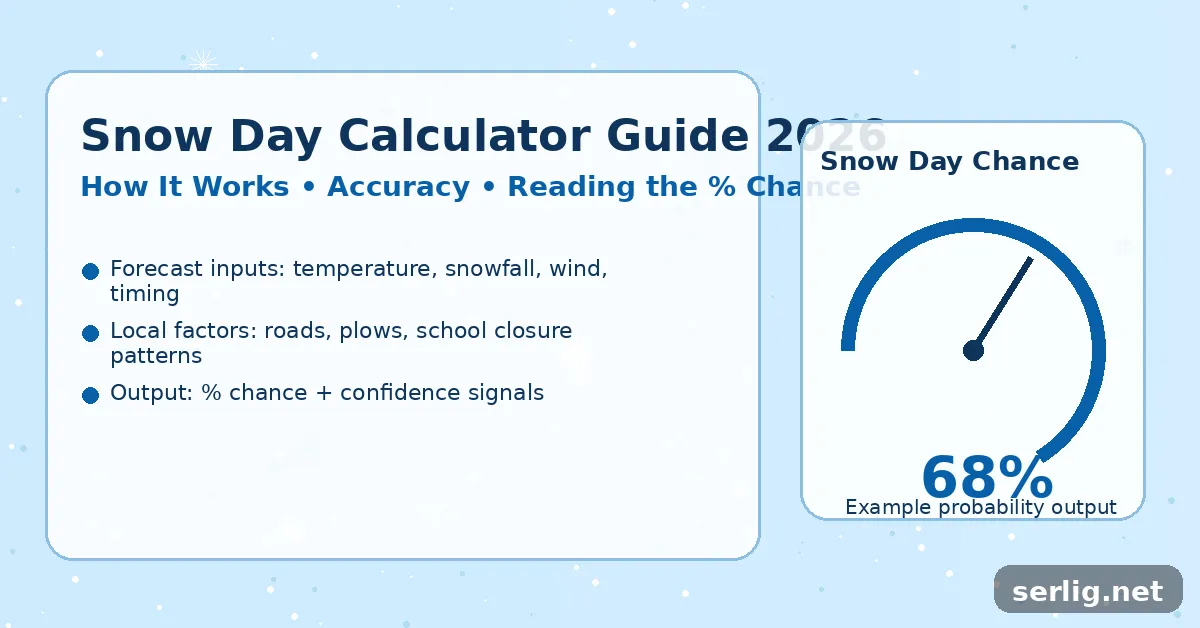
A snow day calculator estimates the chance of a school closure or delay using your location (ZIP/postal code) and weather forecast signals such as snowfall amount and timing, temperature, wind, and ice risk. It may also factor local closure patterns. The result is probabilistic—not an official closure decision.
- A snow day calculator outputs a probability (0–100%) of a delay or closure, based on location + forecast risk factors.
- The biggest drivers are usually storm timing, ice/freezing rain risk, temperature, and snow intensity.
- 30% is “possible,” 60% is “meaningful risk,” and 90% often means “high disruption likely”—but districts can still stay open.
- Use it for planning, then confirm with official district alerts and public weather guidance.
Definition
Snow Day Calculator (definition): An online tool that estimates the likelihood of a school closure or delay due to winter weather by combining location-based inputs (e.g., ZIP/postal code) with forecast signals and uncertainty.
Table: Terms You’ll See (Fast Definitions)
| Term | Meaning | Why it matters for school decisions |
|---|---|---|
| Probability (%) | Likelihood of closure/delay | It’s a risk estimate, not a promise |
| Accumulation | Snow/ice that actually builds up | Roads and buses depend on accumulation |
| Ice accretion | Ice buildup from freezing rain | Small amounts can cause major hazards |
| Rain/snow line | Boundary where precipitation type changes | A small shift can change outcomes |
| Wind chill | “Feels like” cold from wind | Safety + frostbite risk for students waiting |
| Refreeze | Melted water freezing overnight | Black ice risk for morning commute |
What Is a Snow Day Calculator?
A snow day calculator is designed to answer a simple planning question: “What are the chances my school will be closed or delayed because of winter weather?” Instead of giving a yes/no answer, it typically returns a percentage based on your location and weather risk indicators.
What a snow day calculator can do
- Estimate risk for tomorrow morning and near-term windows
- Convert complex forecast inputs into a single probability score
- Help families plan rides, childcare, work schedules, and commute timing
What a snow day calculator cannot do
- Override the school district’s final decision
- See real-time road treatment, bus readiness, staffing constraints, or last-minute administrative judgment
- Eliminate forecast uncertainty (winter forecasts are inherently variable)
How a Snow Day Calculator Works (Step-by-Step)
Most calculators follow a similar logic: location → forecast signals → uncertainty → probability output. The details vary by tool, but the mechanics are consistent across probability-based winter disruption models
The typical workflow
- Identify location risk (ZIP/postal + region)
- Pull forecast signals (snow, ice, temperature, wind, timing)
- Apply uncertainty rules (ranges and probabilities)
- Adjust with local closure tendency patterns (where available)
- Output a closure/delay probability
Step 1 — Location targeting (ZIP/postal code)
Location is the starting point because winter impacts vary drastically over short distances. A ZIP/postal code helps approximate:
- Elevation differences (hilltops vs valleys)
- Proximity to lakes (lake-effect bands)
- Coastal vs inland temperature gradients
- Local snow-removal capacity and typical response time
snow day calculator by ZIP code, snow day predictor by postal code.
Step 2 — Forecast signals that usually drive closures
A calculator typically evaluates a set of weather factors that correlate with disruption risk:
- Snow amount and rate: Heavy snow in a short period often disrupts plowing schedules.
- Storm timing: Overnight accumulation before buses run has higher closure odds than midday snow.
- Temperature profile: Near-freezing forecasts make outcomes volatile (snow vs rain vs sleet).
- Wind and visibility: Blowing snow can reduce visibility and create drifting.
- Ice/freezing rain risk: Often a stronger “closure trigger” than snow totals.
Step 3 — Uncertainty handling (why it’s a probability)
Winter forecasts are uncertain because small changes in:
- Storm track
- Vertical temperature layers (precipitation type)
- Moisture availability
- Snow-to-liquid ratio
…can create large differences in accumulation.
A calculator converts that uncertainty into a probability score rather than a binary decision.
Step 4 — Local “closure tendency” patterns
Some tools incorporate historical tendencies indirectly—because districts differ in:
- Risk tolerance (urban vs rural)
- Bus route length and road type
- Early start times
- Use of remote learning days
- Prior “snow day budget” for the academic calendar
Even without explicit district data, many models attempt to approximate “how likely closures are for this region under similar conditions.”
Table: Inputs vs Typical Impact on Closure/Delay Probability
| Input factor | Typical impact | Why it changes outcomes |
|---|---|---|
| Storm timing (overnight vs midday) | Very high | Affects morning buses + commute safety |
| Ice/freezing rain risk | Very high | Power lines, traction loss, untreated roads |
| Snow rate (in/hr) | High | Plowing cannot keep up during bursts |
| Total snow accumulation | Medium–high | Depends on timing and removal capacity |
| Temperature (near 0°C / 32°F) | High volatility | Determines snow vs rain/sleet mix |
| Wind gusts / blowing snow | Medium–high | Visibility + drifting |
| Refreeze potential | Medium | Black ice in the morning |
| School type/transport reliance | Medium | Bus-heavy districts are more sensitive |
How to Read Snow Forecast Uncertainty (Why the % Changes)
A probability score can change quickly—especially the night before a storm—because the underlying forecast guidance updates frequently and may shift the expected precipitation type or timing.
Low-end, expected, high-end” snowfall ranges
Many official forecasts communicate uncertainty through ranges. You may see:
- A lower plausible amount (low-end)
- An expected or most-likely amount
- A higher plausible amount (high-end)
A snow day calculator often reacts more to scenario risk than to a single number. If the “high-end” scenario grows, the probability may rise—even if the expected total changes only slightly.
Rain/snow line movement (the biggest swing factor)
When temperatures hover near freezing, a shift of a few miles can convert:
- Snow → rain (lower closure risk)
- Rain → snow (higher closure risk)
- Snow → sleet/ice (often highest closure risk)
This is one of the main reasons a score can jump from 30% to 70% within hours.
Why your % may drop during an ongoing storm
A probability is “forward-looking.” As the remaining storm window shortens, the maximum possible additional accumulation drops. That can reduce the probability even while it is still snowing—because the tool may be estimating the chance of tomorrow’s closure, not the fact that it’s currently precipitating.
Table: How to Interpret Probability Ranges
| Probability range | What it usually means | What to do next |
|---|---|---|
| 0–20% | Low disruption likelihood | Monitor updates; don’t assume closure |
| 21–50% | Possible delay/closure | Check timing + ice risk; plan backups |
| 51–80% | Meaningful disruption risk | Prep for schedule changes; watch alerts |
| 81–100% | High likelihood of disruption | Expect changes, but confirm officially |
What Actually Makes Schools Close (Beyond Snow Totals)
School closure decisions are not only about inches of snow. Districts weigh safety, transportation feasibility, and operational readiness—especially during the morning commute window.
Ice and freezing rain (high-impact, low-amount hazard)
Ice is often more dangerous than snow because:
- Traction drops sharply, especially on bridges and untreated roads
- Even small ice accretion can cause slips, collisions, and downed lines
- Treatment effectiveness depends on timing and temperature
A district may close with minimal snow if ice risk is high.
Timing (overnight accumulation vs school hours)
A common pattern:
- Overnight snow that continues into early morning tends to raise closure odds
- Snow starting after students are already in school may lead to early dismissal rather than a full closure
- Rapid temperature drops after afternoon melting increase refreeze risk for buses
Transportation constraints (the bus-route reality)
Bus-heavy districts are sensitive to:
- Hill grades
- Rural road treatment delays
- Narrow routes with limited turnaround
- Visibility during pickup windows
Schools can open with higher snow totals in areas with strong snow response, while closing with less snow in areas with weaker response.
Wind, visibility, and drifting
Blowing snow can create:
- Near-zero visibility in open areas
- Drifts that block roads even after plowing
- Increased accident risk during bus routes
Table: Snow vs Ice vs Sleet vs Wind (School Impact)
| Hazard | What it is | Common school impact |
|---|---|---|
| Snow | Frozen precipitation accumulates | Delays/closures when timing + rate are high |
| Freezing rain | Rain freezing on contact | Closures more likely due to traction + power risk |
| Sleet | Ice pellets | Can accumulate and create slick roads; mixed outcomes |
| Strong wind | Gusts + drifting | Delays/closures in exposed or rural zones |
How Accurate Are Snow Day Calculators in 2026?
Accuracy for probability tools should be evaluated as calibration and usefulness, not as “always right / always wrong.” A tool can be helpful even if a 70% prediction sometimes does not lead to closure—because 70% is still not certainty.

What “accuracy” means for probability predictions
Two practical definitions:
- Calibration: When the tool says 30% across many similar cases, closures happen about 30% of the time.
- Decision usefulness: Whether the probability helps you plan sensibly (backup rides, childcare, commute timing).
When they tend to be more reliable
Probability estimates generally perform better when:
- Forecast confidence is high (clear cold profile, consistent model agreement)
- The storm window overlaps the morning commute
- Ice risk is clearly present or clearly absent
- Totals are well above typical “disruption thresholds” for the region
When they tend to be less reliable
Expect lower reliability when:
- Temperatures hover near freezing (rain/snow line uncertainty)
- Mixed precipitation dominates (sleet/freezing rain transitions)
- Rapid warmups or cool-downs are forecast
- Narrow snow bands (like lake-effect) create highly localized outcomes
Pros and Cons Box
Pros
- Fast risk signal for planning
- Converts complex forecast factors into one score
- Useful for comparing today vs tomorrow risk
Cons
- Not an official closure source
- Local policy and road treatment are not fully observable inputs
- Winter precipitation type changes can cause major swings
How to Use a Snow Day Calculator Correctly (Practical Checklist)
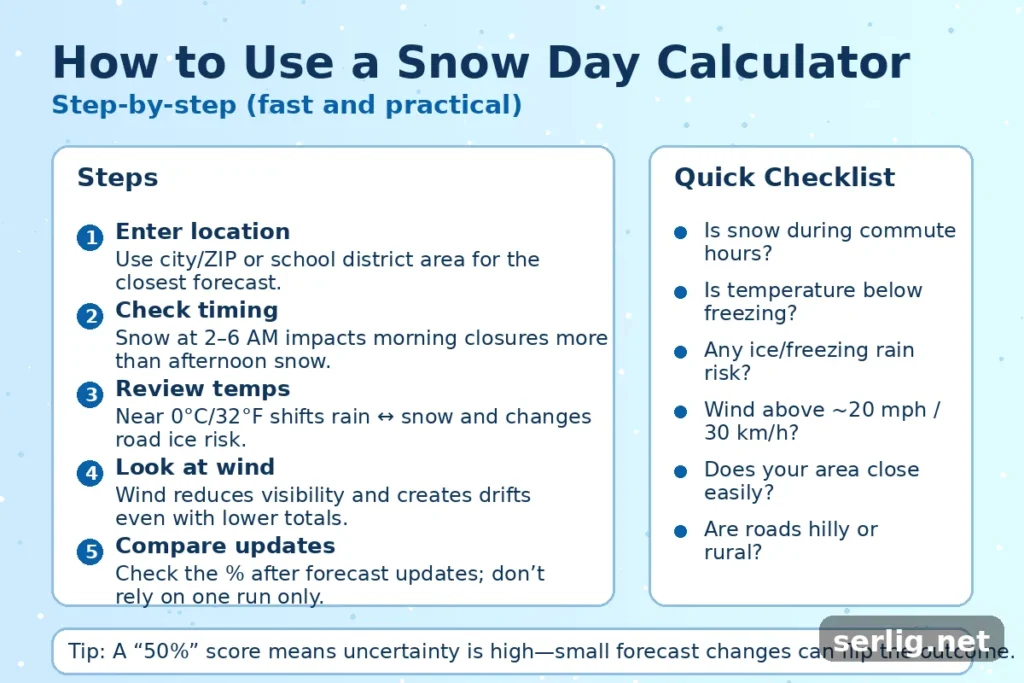
The best approach is to treat the calculator as an early risk indicator, then verify with official sources as the decision window approaches.
Best times to check (for “tomorrow”)
- Evening (6–10 PM): Forecast trends stabilize and school admins begin planning
- Early morning (4–6 AM): Final adjustments occur close to decision time
- Avoid overreacting to midday guesses for next-day storms when uncertainty is still high
What to cross-check before you assume a closure
Use this verification stack:
- Your school district’s official announcements (website/app/text alerts)
- Local public weather guidance (winter weather advisories/warnings)
- Road condition updates (where available)
- Power outage reports (ice storms)
A “decision window” mindset (what matters most)
- Storm timing near pickup hours > total snow that falls after school starts
- Ice risk often outweighs snow totals
- Refreeze potential can turn “wet roads” into a morning hazard
Table: Verification Sources Checklist (No URLs)
| What you need to confirm | Best source type | Why it’s the final check |
|---|---|---|
| Official closure/delay | School district alerts | District is the decision authority |
| Winter hazard level | Public weather agency products | Hazards are communicated regionally |
| Road status | Transportation/road agencies | Buses depend on road treatment |
| Local disruptions | Utilities/outage dashboards | Ice storms can trigger closures |
How does a snow day calculator work?
A snow day calculator estimates closure or delay chances by combining your ZIP/postal code with forecast signals like snow amount and timing, temperature, wind, and ice risk. It uses uncertainty-aware logic (ranges/probabilities) and sometimes local closure tendencies to output a percentage, not an official decision.
Questions and Short Answers
Can a snow day calculator tell me exactly if school will be closed?
A calculator cannot confirm a closure. It provides a probability based on forecast risk factors and uncertainty. Schools decide closures using operational constraints (buses, roads, staffing) plus local conditions. Always confirm using official district announcements.
What percent chance usually means a snow day?
There is no universal percent threshold because districts differ. In many areas, 20–40% indicates “possible,” 50–80% indicates “meaningful risk,” and 80–100% indicates “high risk,” but a district can still open if roads are treated and conditions improve.
Why did my snow day prediction drop even though it’s snowing?
Probability outputs are forward-looking. As the remaining storm time shrinks or the forecast shifts to lower additional accumulation, the estimated chance of tomorrow’s closure can drop. The tool is not measuring “current snow,” it’s estimating the likelihood of disruption.
Are snow day calculators accurate for my ZIP code?
They can be useful for planning but are limited by forecast uncertainty and local decision behavior. Accuracy is higher when precipitation type is clear and timing overlaps bus routes, and lower when rain/snow lines and mixed precipitation are involved.
Do snow day calculators work for delays and early dismissals too?
Many tools estimate both delays and closures, but early dismissals depend heavily on real-time conditions and administrative timing. A probability can suggest risk, but early dismissal decisions often happen after the school day starts.
Takeaways Box (Short, Practical)
- Treat the score as risk, not certainty.
- Ice risk + timing typically drive closures more than raw totals.
- Recheck close to the decision window (night + early morning).
- Use the calculator to plan, then verify with official district alerts.
FAQs
1) What is the best way to use a snow day calculator?
Use it as an early planning tool, then confirm with official school announcements. Check once in the evening and again early morning, because winter forecasts and precipitation type can change quickly.
2) Does ZIP/postal code really matter?
Yes. Winter weather impacts vary sharply over short distances due to elevation, lake-effect bands, and temperature gradients. Location also correlates with different snow removal capacity and closure tendencies.
3) What matters more: snow amount or ice?
Ice and freezing rain often matter more because even small amounts create widespread traction hazards and can cause power disruptions. Snow amount matters most when it is heavy, fast, and timed for the morning commute.
4) Why do two calculators give different percentages?
Tools may use different weather inputs, update timing, weighting of factors (ice vs snow), or regional assumptions about closures. Probability modeling choices can produce different risk scores from the same forecast.
5) Should I trust the “highest %” I see or the latest update?
The latest update is most relevant to tomorrow’s decision window, but the highest % can reflect earlier worst-case scenarios. The safest approach is to track trend + timing and rely on official alerts for the final call.
6) Can a snow day calculator predict closures in Canada?
Many calculators support postal codes and can provide a probability signal, but accuracy depends on the forecast inputs and local closure policies. Always confirm with the relevant school board’s official communications.
Conclusion
A snow day calculator is a probability tool: it translates location and winter forecast risk factors into a single percentage for potential delays or closures. The most important drivers are storm timing, precipitation type (especially ice), temperature profile, and wind impacts. Use it to plan, then verify the final decision using official district announcements.
References
- National Weather Service (NWS): winter weather guidance and probabilistic forecast concepts
- NOAA Weather Prediction Center (WPC): winter storm and snowfall probability products
- Standard meteorological concepts used in public forecasting: precipitation type (snow/sleet/freezing rain), ensemble uncertainty, snowfall accumulation ranges
- Common school operations considerations: transportation safety, road treatment timing, staffing feasibility, and local closure policies