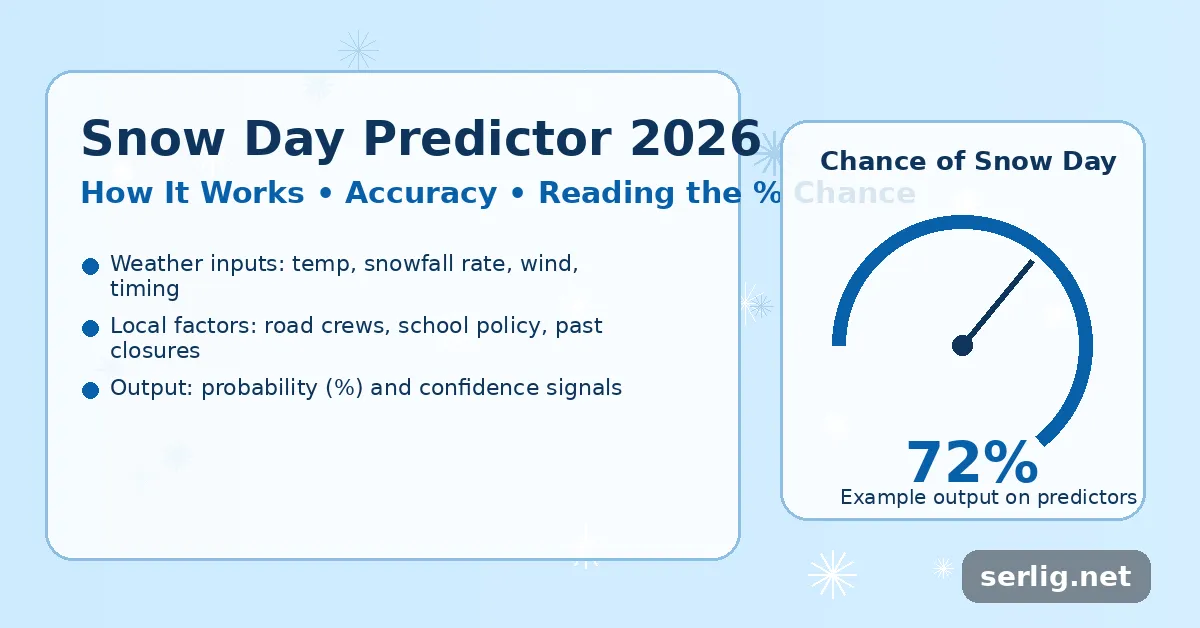
A Snow Day Predictor estimates the probability of a school delay or closure using your ZIP/postal code and forecast risk signals such as snowfall amount and timing, temperature, wind, and ice/freezing rain risk. It outputs a percentage for planning, but final decisions still depend on school district policies, transportation safety, and local road conditions.
- A snow day predictor is a school closure predictor that returns a probability (0–100%) for a snow day or delay.
- The strongest drivers are typically storm timing, precipitation type (ice vs snow), temperature profile, snow rate, and wind/refreeze risk.
- A percentage is risk, not a guarantee—district decisions include buses, roads, staffing, and safety protocols.
- For best results, check twice: night before and early morning, then confirm via official school closing announcements.
Key Definitions (Fast, Quote-Friendly)
| Term | Definition | Why it matters for a Snow Day Predictor |
|---|---|---|
| Snow day probability | A percentage estimate of closure/delay likelihood | Helps plan, but does not confirm closures |
| Accumulation | Snow/ice that builds on surfaces | Roads and bus routes depend on accumulation |
| Snow rate | How fast snow falls (e.g., inches per hour) | High rates overwhelm plowing and reduce visibility |
| Ice accretion | Ice buildup from freezing rain | Small amounts can create widespread hazardous travel |
| Rain–snow line | Boundary where precipitation changes type | Small shifts can flip outcomes from snow to rain or ice |
| Refreeze | Melted water freezing again | Creates black ice and morning commute hazards |
| Forecast uncertainty | Range of plausible outcomes | Explains why a snow day predictor changes overnight |
What Is a Snow Day Predictor?
A Snow Day Predictor 2026 is an informational planning tool that estimates the chance of winter weather school closings, including snow day delays and school cancellation scenarios. It converts multiple weather risk factors into a single probability score, answering “Will school be closed tomorrow?” with a percentage, not a yes/no.
Snow Day Predictor vs Snow Day Calculator (are they different?)
In practice, “snow day predictor” and “snow day calculator” are often used interchangeably. Both aim to estimate snow day probability using location and forecast signals. “Predictor” usually emphasizes probability and risk modeling, while “calculator” can imply a simple input/output tool—both typically deliver the same user outcome: a chance of no school.
What it can predict (closure/delay probability)
A snow day predictor can estimate the likelihood of:
- School closure (full cancellation)
- Delayed start (late opening)
- Higher disruption risk (e.g., significant hazard potential)
It is especially useful as a snow day chance tomorrow indicator for parents, students, and staff.
What it cannot predict (final decisions and local operations)
A snow day predictor cannot reliably know:
- District-specific decision thresholds and last-minute judgment
- Road treatment status, plow timing, and route-by-route bus feasibility
- Staffing constraints, building issues, or power outages that affect operations
Based on school transportation safety practices, districts prioritize safe bus travel windows and morning visibility—factors a generic model can only approximate.
How a Snow Day Predictor Works (Step-by-Step)
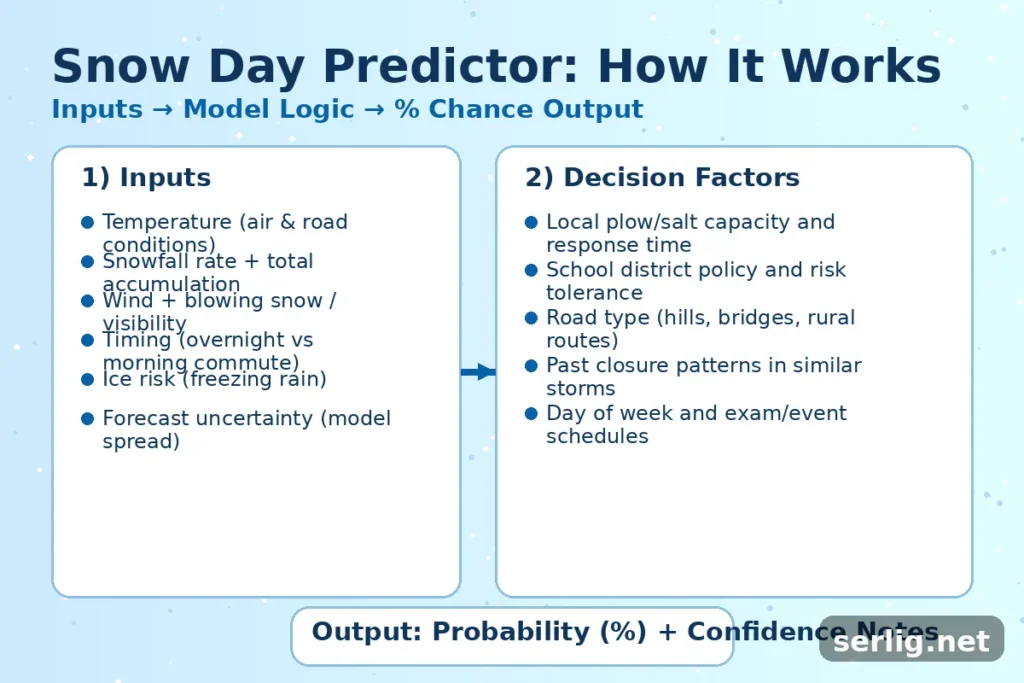
A snow day predictor by ZIP code generally follows a consistent workflow: location → forecast risk signals → uncertainty handling → probability output. The score reflects the model’s best estimate of disruption likelihood given the latest forecast conditions.
Step 1 — Location inputs (ZIP/postal code)
The predictor starts with ZIP/postal code because winter weather impacts vary dramatically across short distances due to:
- Elevation and terrain
- Lake-effect or localized snow bands
- Coastal temperature moderation
- Urban heat island effects
- Regional snow response capacity
This is why “snow day predictor for my zip code” searches are common—location is the strongest baseline variable.
Step 2 — Snow signals (total, rate, and timing)
Most predictors weigh:
- Total snowfall accumulation
- Snow rate (how intense it is)
- Storm timing relative to morning bus routes and commute windows
A moderate total can still cause major disruption if it falls quickly overnight. Conversely, a higher total can be manageable if it falls gradually with strong road treatment.
Step 3 — Temperature profile and precipitation type (snow vs sleet vs freezing rain)
Temperature near freezing introduces volatility. Predictors often adjust risk based on precipitation type:
- Snow: disruptive mainly when heavy, fast, or poorly timed
- Sleet: can compact and create slippery layers
- Freezing rain: frequently high-impact even at low amounts due to traction loss and potential outages
This is why freezing rain school closure risk is a major supporting topic.
Step 4 — Wind, visibility, drifting, and refreeze
Wind and thermal conditions can amplify hazards:
- Wind reduces visibility (blowing snow)
- Gusts create drifting, blocking roads
- Refreeze creates black ice after melting
- Wind chill affects safety for students waiting outside
These variables often explain why two days with similar snowfall totals can produce different outcomes.
Step 5 — Uncertainty → probability score (0–100)
Modern forecasting is uncertainty-aware. Predictors typically translate uncertainty into probability, using:
- Ranges of possible accumulation
- Confidence signals from forecast trends
- Sensitivity to rain–snow line shifts
Based on industry practices in probabilistic forecasting, the score is best interpreted as risk over a specific time window (often “tomorrow morning”), not as a promise.
Table: Inputs vs Impact on School Closure Probability
| Input factor | Typical impact | Operational reason (school-focused) |
|---|---|---|
| Storm timing (overnight vs midday) | Very high | Determines morning road safety and bus feasibility |
| Ice/freezing rain risk | Very high | Rapid traction loss; possible outages and unsafe sidewalks |
| Snow rate (intensity) | High | Plows can’t keep up; visibility drops during pickups |
| Total snowfall accumulation | Medium–high | Depends on timing and local snow response capacity |
| Temperature near freezing | High volatility | Drives precipitation type changes and refreeze risk |
| Wind gusts / blowing snow | Medium–high | Drifting + near-zero visibility on open roads |
| Refreeze / black ice potential | Medium | Morning commute risk increases sharply |
| Transportation reliance (bus-heavy) | Medium | More sensitivity to route conditions and timing |
The Biggest Drivers of School Closures in Winter Weather
School closure decisions are not based on inches alone. A school closing predictor is most accurate when it reflects the real decision drivers districts use: timing, ice risk, transport safety, and operational readiness.
Timing matters most (overnight vs daytime)
Timing often outranks totals because:
- Overnight accumulation impacts early-morning travel
- Morning snowfall overlaps bus routes and staff commutes
- Late-start storms may lead to early dismissal instead of closure
This explains many “will school be closed tomorrow” outcomes: the same snow total can mean different things depending on when it falls.
Ice/freezing rain often matters more than snow totals
Ice is a high-impact hazard because it:
- Reduces traction immediately
- Increases crash and slip risks
- Can cause power disruptions and unsafe walking conditions
A district may close for minimal snow if freezing rain is likely. This is why snow day vs delay predictor content should always include ice.
Transportation realities (bus routes, rural roads, hills, bridges)
District decisions depend on whether buses can run safely:
- Rural routes may be untreated longer
- Hills and bridges ice over earlier
- Visibility issues create pickup hazards
- Turnaround areas may be blocked by plows or drifts
Based on transportation safety protocols, if safe bus operation is uncertain, districts lean toward delay or closure.
Operational constraints (staffing, building access, outages)
Even when roads are improving, closures can occur due to:
- Staff inability to commute
- Parking lots and sidewalks not cleared
- Heating issues or power outages
- Supply and maintenance constraints
A predictor can approximate weather risk, but these operational variables are local.
Table: Hazard Comparison (Snow vs Sleet vs Freezing Rain vs Wind)
| Hazard | What it is | Typical school impact | Why predictors treat it differently |
|---|---|---|---|
| Snow | Frozen precipitation accumulation | Delays/closures when intense or poorly timed | Sensitive to timing + rate + treatment capacity |
| Sleet | Ice pellets, often compacts | Slippery roads; mixed outcomes | Impacts traction but varies by temperature |
| Freezing rain | Rain freezing on contact | Closures more likely | Low amounts can produce severe travel hazards |
| Wind/drifting | Gusts + blowing snow | Closures in exposed areas | Visibility and drifts can block routes quickly |
How to Read the Snow Day Probability % (0–100)
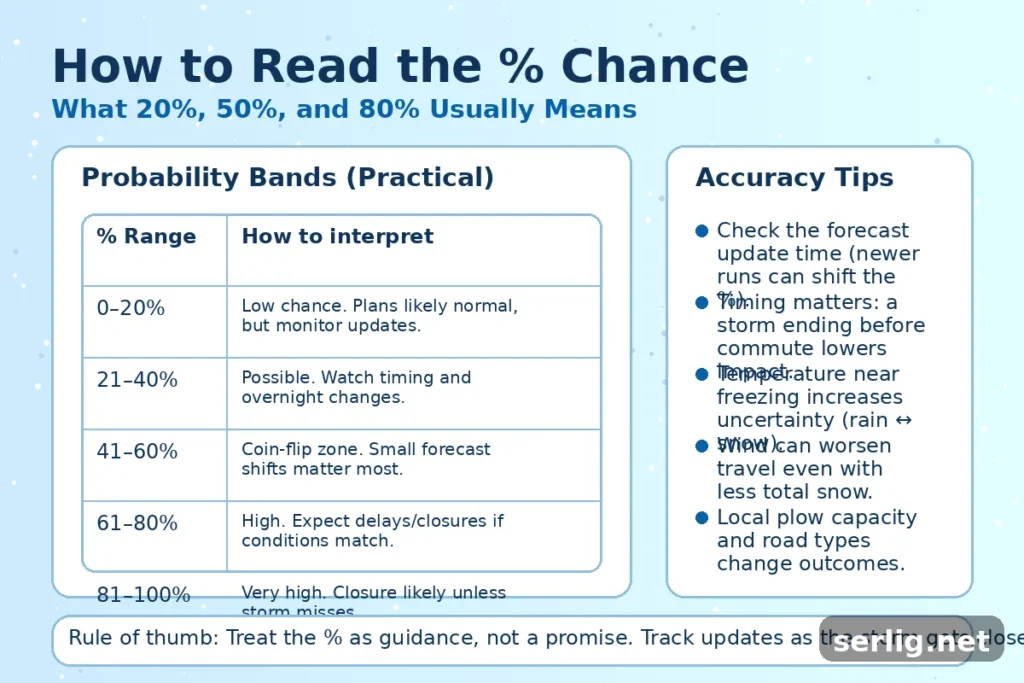
A snow day predictor outputs probability, which is not a guarantee. The best way to use it is to map probability ranges to practical planning actions—especially for parents and students managing schedules.
What 20% means in practice
Around 0–20% generally indicates low disruption likelihood. You should:
- Monitor updates
- Avoid assuming a closure
- Focus on precipitation type changes (rain vs snow vs ice)
This range often corresponds to “possible but not likely” outcomes.
What 50–60% means in practice
Around 50–60% often indicates meaningful risk:
- Plan backup transportation or childcare
- Expect a delay to be plausible
- Watch timing and ice risk closely
Many searches like “what does 60 percent snow day chance mean” are driven by this planning threshold.
What 80–90% means in practice
Around 80–90% typically signals high disruption risk:
- Prepare for closure or major delay
- Expect official announcements near decision windows
- Still confirm via district alerts
Even at high values, decisions can differ by district, road treatment, or last-minute forecast improvements.
Common misreads (treating probability as a guarantee)
Common errors:
- Treating 60% as “it will close” (it still implies uncertainty)
- Ignoring ice risk because “snow totals are low”
- Checking too early and not rechecking near decision time
- Comparing different tools without noting update time
Table: Probability Ranges → Recommended Actions
| Probability % | Practical interpretation | Recommended action |
|---|---|---|
| 0–20 | Low chance of disruption | Monitor, but plan for normal day |
| 21–50 | Possible delay/closure | Prepare backups; track precipitation type |
| 51–80 | Meaningful disruption risk | Expect schedule changes; check district alerts |
| 81–100 | High disruption likelihood | Prepare for closure/delay; confirm officially |
Internal Summary Box: If you only remember 5 rules
- Timing + ice risk move scores more than totals.
- 50–60% means “plan for change,” not “guaranteed.”
- Recheck at night and early morning.
- Wind/refreeze can turn “manageable snow” into unsafe travel.
- District announcements are the final authority.
Why the Prediction Changes Overnight (Forecast Uncertainty Explained)
Many users search “why snow day predictor changes overnight” because the score can move quickly. This is normal: forecasts update as new observations arrive and models adjust storm track, precipitation type, and timing.
Rain–snow line shifts (small change, big outcome)
Near-freezing events are sensitive. A small shift can change:
- Snow → rain (lower disruption)
- Rain → snow (higher disruption)
- Snow → sleet/freezing rain (often highest disruption)
This is a core reason probabilities jump between evening and early morning.
Mixed precipitation transitions (snow → sleet → freezing rain)
Mixed precipitation creates layered hazards:
- Snow adds accumulation
- Sleet compacts into slippery surfaces
- Freezing rain coats surfaces with glaze ice
Predictors often increase risk when freezing rain becomes more likely—even if snow totals decrease.
Model updates and new observations
Overnight updates can reflect:
- Radar and satellite trends
- Temperature changes at different elevations
- New storm track guidance
- Shifts in precipitation intensity bands
Based on forecasting best practices, short-range updates can significantly improve (or revise) the expected outcome.
Why % can drop during a storm (forward-looking scoring)
A probability score can drop while it’s still snowing because:
- The remaining storm duration shrinks
- Expected additional accumulation decreases
- The tool is estimating “tomorrow’s closure risk,” not “current snowfall”
This explains “why snow day predictor percentage dropped” queries.
Mini Takeaway Box: Trend vs Noise
- One update is noise; multiple updates in the same direction is a trend.
- Watch precipitation type and timing changes more than tiny total changes.
- Compare scores only if the update time window is similar.
Snow Day Predictor Accuracy in 2026 (What “Accurate” Really Means)
When users ask “how accurate is a snow day predictor,” they often expect a yes/no scorecard. For probability tools, accuracy is better framed as calibration and planning usefulness.
Accuracy definition for probability tools
Two practical measures:
- Calibration: Over many similar days, does “30%” behave like ~30%?
- Usefulness: Does the score reliably signal when you should prepare for delays or closures?
This is why “right/wrong” evaluation can be misleading for probabilistic outputs.
H3: What improves reliability
A predictor tends to be more reliable when:
- Temperatures are clearly below freezing (stable precipitation type)
- Forecast guidance is consistent across updates
- Snow bands are broad rather than narrow/localized
- Storm timing aligns with commute windows
What reduces reliability
A predictor tends to be less reliable when:
- Temperatures hover near freezing (rain–snow line uncertainty)
- Mixed precipitation dominates (sleet/freezing rain transitions)
- Narrow lake-effect bands produce hyper-local outcomes
- Rapid warmups or refreeze cycles are forecast
These are the conditions where “snow day predictor accuracy” is inherently limited.
Why two predictors may disagree
Two tools can output different probabilities because they may:
- Update at different times
- Weight ice risk and timing differently
- Use different baseline assumptions for a region’s closure tendency
- Interpret uncertainty ranges differently
This is why comparing tools works best when you focus on drivers (ice, timing, temp) rather than just the number.
Practical expectation setting (planning tool vs confirmation)
A snow day predictor should be treated as:
- A risk dashboard for planning
- A way to prioritize what to monitor
- Not a replacement for official announcements
Based on operational decision-making in schools, the last call depends on safety, transport feasibility, and real-time conditions.
Pros and Cons Box
Pros
- Fast estimate of snow day probability for tomorrow
- Helpful for planning childcare, alarms, and commute decisions
- Converts complex factors into a clear percentage
Cons
- Cannot see district-specific constraints in real time
- Sensitive to rain–snow line and mixed precipitation uncertainty
- Not an official school closing announcement
How to Use a Snow Day Predictor Correctly (Checklist)
Using a snow day predictor for parents planning or for staff commutes is most effective when you follow a routine: check at high-signal times, interpret the percentage correctly, and verify through authoritative channels.
Best times to check (evening + early morning)
Recommended check schedule:
- Evening (night before): capture the best planning signal
- Early morning: capture final forecast adjustments near decision time
This aligns with common district decision windows and weather update cycles.
What to verify before assuming closure (district alerts first)
Verification order:
- District alerts (text/app/website announcements)
- Public weather advisories/warnings (for hazard context)
- Road condition updates (where available)
- Utility outage reports during ice events
This supports “snow day prediction vs school district decision” clarity: the district is always final.
A simple decision checklist for parents/students
- Is freezing rain possible? (If yes, risk rises)
- Will the heaviest precipitation hit before buses run?
- Are temperatures near freezing (type could change)?
- Is wind strong enough for drifting/visibility issues?
- Does refreeze risk exist after melting?
What to do for delays vs closures vs early dismissals
- Delay: often used when conditions may improve after sunrise or after plows catch up
- Closure: more likely with severe ice, heavy overnight snow, or high visibility risk
- Early dismissal: common when a storm intensifies midday and travel may worsen later
Table: Verification Sources (No URLs)
| What you need to confirm | Best source type | Why it matters |
|---|---|---|
| Official closure/delay | School district / school board alerts | Only the district confirms schedules |
| Hazard severity context | Public weather agency advisories/warnings | Summarizes expected impacts and timing |
| Road travel feasibility | Road/transport departments | Buses rely on treated routes and visibility |
| Ice-storm disruption | Utility outage reporting | Power issues can force closures |
Internal Summary Box: 10-minute verification routine
- Check the latest snow day probability.
- Check precipitation type and timing (snow vs ice, overnight vs morning).
- Look for hazard advisories/warnings.
- Check district alerts.
- Make a plan for delay vs closure (alarm, childcare, commute).
Quick Scenario Examples (Realistic Use Cases)
Scenarios help answer long-tail searches like “how to use a snow day predictor correctly” because they show how the same total can produce different outcomes depending on timing and type.
Scenario 1 — Heavy overnight snow, cold temperatures
- Forecast: steady snow overnight, clearly below freezing
- Risk drivers: timing overlaps bus routes, accumulation is stable
- Likely result: elevated closure/delay probability, especially in bus-heavy districts
Scenario 2 — Light snow, significant freezing rain risk
- Forecast: minimal snow totals, but freezing rain possible near morning
- Risk drivers: traction loss, potential outages, unsafe sidewalks
- Likely result: higher closure probability than totals suggest
Scenario 3 — Mixed precipitation + temperature swing
- Forecast: snow turning to sleet/rain, then rapid drop and refreeze
- Risk drivers: refreeze creates black ice; precipitation type uncertainty
- Likely result: probability swings overnight; delay or closure depends on timing
Scenario 4 — Wind-driven drifting in rural zones
- Forecast: moderate snow totals, strong gusts, open-road exposure
- Risk drivers: drifting blocks roads; visibility impacts pickups
- Likely result: delays/closures more likely in rural districts than urban centers
Quick Answers (Concise, Quote-Friendly)
Can a snow day predictor tell me exactly if school is closed?
No. It estimates probability based on forecast risk factors. Official closures come from school districts, which also consider transportation safety, staffing, and real-time conditions.
What percent chance guarantees a snow day?
No percentage guarantees a closure. A high probability indicates higher risk, but districts can stay open if roads are treated and conditions improve before the commute window.
Why did my snow day probability change so fast?
Probabilities change when forecast timing, precipitation type (rain/snow/ice), or storm track shifts. Near-freezing events and mixed precipitation can cause the fastest swings.
Does it work for delays too?
Many predictors estimate both delays and closures as disruption outcomes. Delays are often chosen when conditions may improve after plows and daylight increase safety.
Is ice more dangerous than snow for closures?
Often, yes. Freezing rain can create hazardous travel with small amounts, increasing closure likelihood even when snow totals are low.
Conclusion
Snow Day Predictor 2026 tools estimate snow day probability using your ZIP/postal code and key forecast drivers: storm timing, precipitation type (especially ice), temperature profile, wind, and refreeze risk. The score is best used for planning, then confirmed via official district announcements and hazard guidance. Interpreting the percentage as risk—not certainty—leads to better decisions.
FAQs
1) What is a Snow Day Predictor?
A Snow Day Predictor is a tool that estimates the likelihood of school delays or closures due to winter weather, expressed as a percentage probability.
2) How does a snow day predictor work?
It combines location (ZIP/postal code) with forecast risk signals such as snow amount and timing, temperature, wind, and ice risk, then converts uncertainty into a probability score.
3) How accurate is a snow day predictor for my ZIP/postal code?
It can be useful for planning but is limited by forecast uncertainty and local decision factors. Accuracy is generally higher in clearly cold, consistent-signal storms and lower during mixed precipitation and near-freezing events.
4) Why does freezing rain increase closure chances?
Freezing rain can create widespread traction hazards with small amounts and may trigger outages or unsafe walking conditions, often causing closures even when snow totals are low.
5) How often should I check the prediction?
Check twice: the evening before for planning and early morning for final updates near decision time.
6) Can it predict delays and early dismissals?
Delays are often predictable as a disruption risk, but early dismissals depend heavily on real-time storm evolution and district timing decisions after school begins.
7) What is the best way to confirm school closings?
Use official district or school board announcements as the final source of truth, supported by public hazard guidance and road condition updates.
References (Credible Sources Only)
- National weather agencies’ winter weather guidance (advisories, warnings, and impact-based forecasting concepts)
- National forecast centers’ winter precipitation probability products (snow and ice risk frameworks)
- Standard meteorological concepts used in operational forecasting: precipitation type, accumulation, refreeze/black ice, wind-driven visibility reduction, forecast uncertainty and ensembles
- School operations and transportation safety practices: bus route feasibility, road treatment timing, staffing and building access considerations, district alert protocols