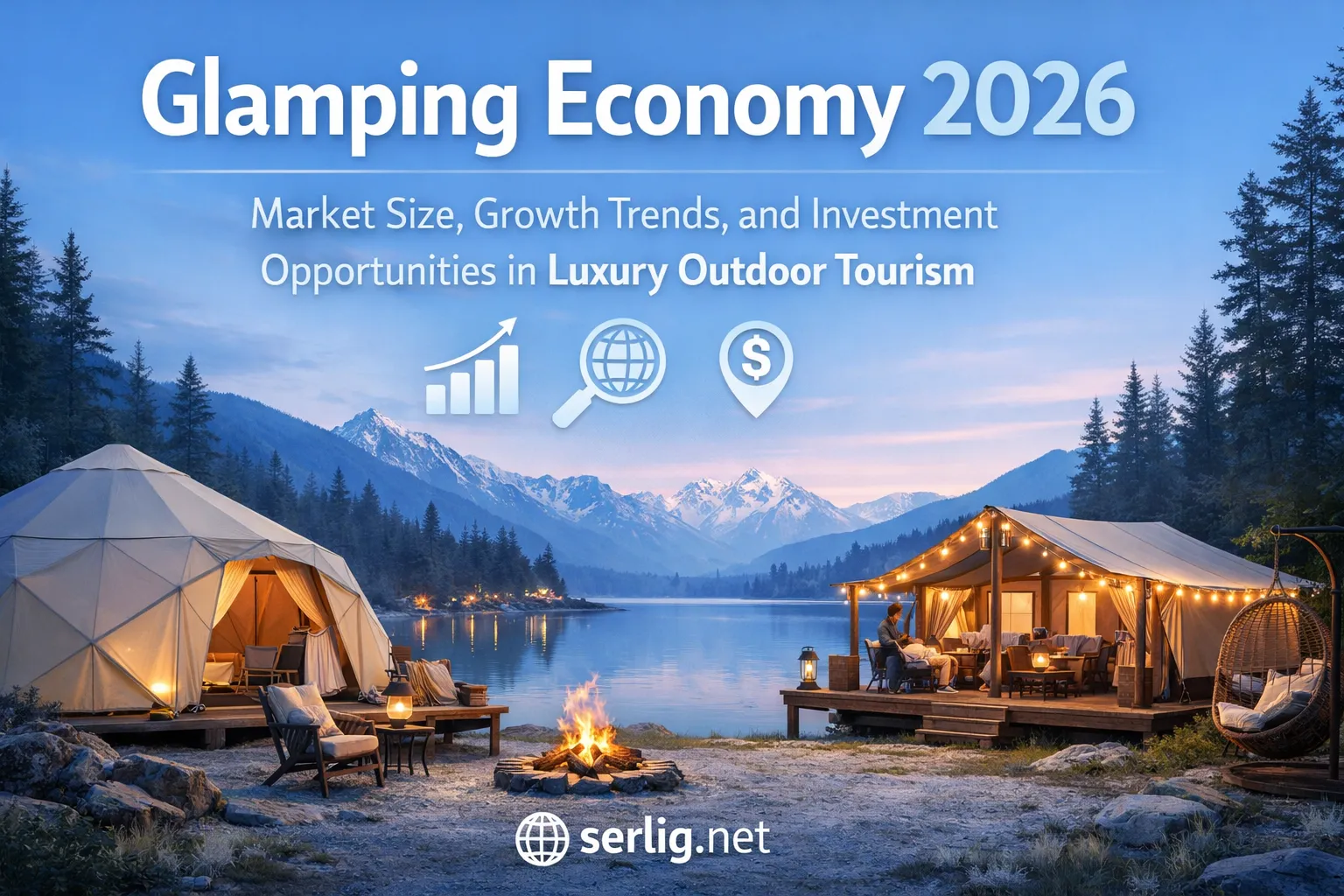
The Glamping Economy is changing the way people travel and stay.
Today, many travelers want more than just a hotel room. They want comfort, fresh air, and a special experience at the same time.
Glamping, which means “glamorous camping,” gives people a chance to stay close to nature without giving up comfort. Guests sleep in real beds, use private bathrooms, and enjoy beautiful outdoor locations. This mix of comfort and nature has created a fast-growing market known as the Glamping Economy.
In 2026, this economy is no longer a small trend. It has become a serious part of the global tourism and hospitality industry. Travelers, business owners, and investors are all paying attention to glamping because it offers strong demand, flexible business models, and long-term growth potential.
This article explains the Glamping Economy in clear and simple words. It covers market growth, key trends, business opportunities, and what the future looks like beyond 2026.
What Is the Glamping Economy?
The Glamping Economy refers to the business and market built around luxury camping experiences. It combines outdoor travel with comfort, design, and modern services. Instead of rough tents and shared facilities, glamping offers real beds, private bathrooms, electricity, and scenic natural locations.
At its core, the Glamping Economy sits between traditional camping and hotels. Camping focuses on simplicity and survival, while hotels focus on convenience and standard comfort. Glamping blends the best of both. Guests stay close to nature but still enjoy comfort, privacy, and unique experiences.
This economy includes many connected parts, such as:
- Glamping accommodation providers
- Tourism and hospitality services
- Landowners and rural destinations
- Online booking platforms
- Eco-friendly technology and infrastructure
The Glamping Economy also supports experience-based travel. Travelers are not just paying for a place to sleep. They are paying for memories, views, and a feeling of escape. This makes glamping attractive to modern travelers who value experiences over traditional luxury.
From a business point of view, the Glamping Economy allows flexible models. Operators can start small, use unused land, and grow over time. Lower construction needs and strong demand make it appealing for investors and tourism developers.
In simple words, the glamping economy is about turning nature-based stays into comfortable, profitable, and sustainable travel experiences.
ALSO READ :: Candizi in 2026: Benefits, Uses & What Science Really Says
Why the Glamping Economy Is Growing in 2026
Travel in 2026 is more focused on comfort, privacy, and meaningful experiences. Many travelers want to enjoy nature but do not want the discomfort of traditional camping. At the same time, hotels often feel crowded and repetitive. This shift in preferences has helped the Glamping Economy grow steadily.
Luxury outdoor stays offer a balance between comfort and nature. Guests enjoy real beds, private bathrooms, fresh air, and scenic views. These features make glamping attractive to families, couples, and solo travelers. Unique stays such as domes, cabins, and treehouses create strong memories, which increases guest satisfaction and repeat bookings. This demand plays a key role in the expansion of the Glamping Economy.
Remote work has also changed how people travel. Many professionals can now work from anywhere, allowing them to stay longer in peaceful locations. Nature-based accommodations provide calm environments with fewer distractions. With reliable internet and basic work facilities, glamping has become suitable for both short trips and extended stays, further supporting the Glamping Economy.
Sustainability is another important factor. Travelers are more aware of environmental impact and prefer responsible tourism options. Luxury outdoor accommodations often use eco-friendly materials, renewable energy, and low-impact designs. This approach aligns well with global sustainability goals and strengthens the long-term future of the Glamping Economy.
Global Market Overview
The Glamping Economy operates on a global scale. It is active across developed and emerging markets.
Market Presence
- North America leads in demand and innovation
- Europe focuses on eco-tourism and rural stays
- Asia-Pacific shows fast growth due to rising incomes
- Middle East invests in luxury desert and nature tourism
The market grows steadily because glamping adapts well to local cultures and landscapes. From forests and mountains to deserts and coastlines, the Glamping Economy fits many environments.
Unlike traditional hotels, glamping does not require heavy construction. This allows faster development and lower long-term risk.
Market Growth Direction (2026)
In 2026, the Glamping Economy is moving in a strong and steady growth direction. Demand for nature-based and experience-focused travel continues to rise, and glamping has become a trusted choice rather than a temporary trend. Travelers now see glamping as a comfortable and reliable alternative to hotels and traditional camping.
One clear growth signal in the Glamping Economy is year-round demand. In earlier years, outdoor stays were mostly seasonal. Today, better design, insulation, and climate control allow glamping sites to operate for longer periods. This increases occupancy rates and creates more stable revenue for operators.
Geographic expansion is also shaping the growth direction. The Glamping Economy is no longer limited to forests and national parks. New glamping sites are opening in deserts, coastal areas, rural regions, and mountain locations. This wider presence helps attract different types of travelers and reduces dependence on a single destination or season.
Investment activity further supports growth. More landowners, small investors, and hospitality brands are entering the Glamping Economy because startup costs are often lower than traditional hotels. Flexible business models allow gradual expansion, which reduces risk and encourages long-term planning.
Technology continues to push the market forward. Online booking platforms, digital marketing, and smart management tools make it easier for operators to reach global travelers. At the same time, guests can quickly discover unique stays, increasing visibility and demand.
Overall, the Glamping Economy in 2026 shows a clear path of steady expansion. Strong demand, wider regional adoption, and flexible investment options point toward sustainable long-term growth rather than short-term spikes.
Core Growth Drivers of the Glamping Economy
Experience-Driven Travel
Modern travelers want stories, not schedules.
They want places that feel special and personal.
The Glamping Economy offers:
- Treehouses in forests
- Domes under the stars
- Safari tents near wildlife
- Lakeside and desert retreats
These experiences feel unique and memorable. Social media sharing also boosts demand and brand visibility.
Sustainability and Eco-Tourism
Sustainability is no longer optional.
Many travelers care about how and where they stay.
The Glamping Economy supports:
- Low-impact structures
- Solar and off-grid systems
- Natural materials
- Smaller environmental footprints
Because glamping uses land carefully, it aligns well with eco-tourism policies and responsible travel trends.
Remote Work and Lifestyle Changes
Remote work has become normal in 2026.
People can work from almost anywhere.
The Glamping Economy benefits from this shift:
- Quiet environments improve focus
- Nature reduces stress
- Long stays increase revenue per guest
Many glamping sites now offer fast internet, workspaces, and extended stay packages.
Technology and Digital Platforms
Technology helps the Glamping Economy scale efficiently.
Key tools include:
- Online booking systems
- Dynamic pricing
- Smart energy management
- Contactless check-in
These tools reduce operating costs and improve guest experience, making glamping easier to manage and grow.
Why the Glamping Economy Has Long-Term Potential
The Glamping Economy has strong long-term potential because it fits how travel, work, and lifestyle are changing. Travelers are not only looking for places to stay. They are looking for comfort, privacy, and meaningful experiences in natural settings. Glamping meets these needs better than traditional hotels or basic camping.
One key reason for long-term growth is flexibility. The Glamping Economy works in many locations, including forests, deserts, mountains, and rural areas. It does not require heavy construction, which makes development faster and more adaptable. This flexibility allows operators to adjust their offerings as traveler demand changes over time.
Another reason is steady demand from different traveler groups. Families, couples, solo travelers, and remote workers all find value in glamping. This wide audience reduces dependence on one type of customer and helps the Glamping Economy stay stable even when travel trends shift.
Sustainability also supports long-term potential. Many glamping sites use eco-friendly materials, renewable energy, and low-impact designs. As governments and travelers place more importance on responsible tourism, this approach aligns well with future regulations and expectations. This makes the Glamping Economy more resilient than traditional hospitality models.
Technology adds further strength. Online booking platforms, smart energy systems, and digital marketing tools make operations more efficient and scalable. These tools help businesses grow without losing quality, which supports long-term success.
Overall, the Glamping Economy is not built on short-term hype. Its mix of experience-based travel, flexible development, sustainability, and broad customer appeal gives it a strong foundation for lasting growth in the global tourism industry.
Consumer Demand in the Glamping Economy (2026)
The Glamping Economy is driven by changing traveler needs.
People now look for comfort, privacy, and nature together.
Glamping guests are not one single group.
They come from different backgrounds but share similar goals.
Who Chooses Glamping?
The main customer groups in the Glamping Economy are:
- Millennials who value experiences
- Gen Z travelers who like unique stays
- Families who want safe outdoor trips
- Couples looking for quiet retreats
- Remote workers seeking peaceful places
These travelers prefer glamping because it feels personal. Hotels often feel crowded and generic. Camping can feel uncomfortable. Glamping offers a balance that fits modern lifestyles.
Why Travelers Prefer Glamping Over Hotels
Hotels focus on rooms.
Glamping focuses on experiences.
People choose the Glamping Economy because:
- They get more privacy
- They stay closer to nature
- They feel relaxed and disconnected
- They enjoy unique designs and views
Many guests say glamping feels more meaningful than a normal hotel stay. This emotional value increases repeat visits and strong reviews.
Booking Behavior and Stay Patterns
Travelers in the Glamping Economy often:
- Book short weekend trips
- Plan special occasions
- Stay longer for work-from-nature trips
Many glamping sites see:
- Higher weekend occupancy
- Longer stays than hotels
- Flexible pricing based on season
This behavior helps operators manage revenue better.
Types of Glamping Accommodations
The Glamping Economy includes many accommodation styles. Each type serves a different kind of traveler.
Safari Tents
Safari tents are one of the most popular options.
They offer:
- Spacious layouts
- Luxury interiors
- Strong outdoor connection
They work well in forests, parks, and wildlife areas.
Domes and Pods
Domes and pods feel modern and stylish.
They are popular because:
- They look unique
- They work in many climates
- They attract younger travelers
Many domes offer panoramic views, which adds premium value.
Treehouses
Treehouses are playful and memorable.
They attract:
- Families
- Couples
- Adventure-focused guests
Treehouses often charge higher prices because they are rare and exciting.
Cabins and Yurts
Cabins and yurts offer a traditional feel with modern comfort.
They suit:
- Cold climates
- Year-round stays
- Long-term guests
These units are durable and easy to maintain.
How Accommodation Type Impacts Revenue
In the Glamping Economy, the type of unit matters.
Revenue depends on:
- Design appeal
- Comfort level
- Location
- Privacy
Unique units usually earn higher nightly rates. Simple but comfortable units earn steady long-term income. A mix of unit types often works best.
Business Models in the Glamping Economy
One strength of the Glamping Economy is flexible business models. Operators can choose based on budget, land access, and goals.
Owned Glamping Resorts
This model gives full control.
Operators:
- Own the land or lease long-term
- Build and manage units
- Control branding and pricing
Pros:
- Higher profit potential
- Strong brand value
Cons:
- Higher startup cost
- More management responsibility
Land Lease and Partnership Model
This model works well for beginners.
In this setup:
- Landowner provides land
- Operator builds and runs units
- Revenue is shared
Pros:
- Lower initial cost
- Faster setup
Cons:
- Shared profits
- Limited long-term control
Marketplace Listing Model
Some operators list their units on platforms.
This model:
- Reduces marketing effort
- Increases visibility
- Simplifies bookings
Pros:
- Easy market access
- Lower risk
Cons:
- Platform fees
- Less brand ownership
Hybrid Hospitality Models
Some hotels now add glamping units.
This creates:
- More room variety
- New customer segments
- Higher land use efficiency
This hybrid model is growing fast within the Glamping Economy.
Why Business Models Matter in 2026
The Glamping Economy is flexible by design.
Operators can scale slowly or grow fast.
This flexibility allows:
- Small investors to enter
- Large brands to expand
- Rural landowners to earn income
As a result, the Glamping Economy supports both local businesses and global tourism brands.
Cost Structure in the Glamping Economy
Understanding costs is very important in the Glamping Economy.
Glamping is flexible, but it is still a real business.
Costs depend on:
- Location
- Size of the site
- Type of accommodation
- Level of comfort
Main Setup Costs
Common setup costs include:
- Land preparation
- Glamping unit purchase or build
- Furniture and interiors
- Utilities like water, power, and internet
Compared to hotels, glamping usually needs:
- Less concrete
- Less heavy construction
- Shorter build time
This makes entry into the Glamping Economy easier for many investors.
Operating Costs
Operating costs are ongoing expenses.
These include:
- Staff salaries
- Cleaning and maintenance
- Utilities
- Marketing and booking fees
Many glamping sites keep costs low by:
- Using solar power
- Hiring small local teams
- Automating bookings
Smart cost control improves profit margins in the Glamping Economy.
Pricing and Revenue Logic
Pricing in the Glamping Economy is experience-based.
Guests pay for:
- Privacy
- Views
- Design
- Location
Typical pricing strategies include:
- Higher weekend rates
- Seasonal pricing
- Special packages for couples or families
Because glamping feels unique, guests accept higher prices than normal camping.
Profit Potential and ROI
Profit depends on planning and execution.
Well-managed glamping sites often see:
- Faster break-even than hotels
- Strong weekend occupancy
- High guest satisfaction
The Glamping Economy benefits from:
- Lower fixed costs
- Flexible pricing
- Repeat customers
ROI improves when operators focus on guest experience, not just capacity.
Investment Opportunities in the Glamping Economy (2026)
In 2026, the Glamping Economy offers strong investment opportunities because demand for nature-based, experience-driven travel is rising. Many travelers want comfort and privacy in outdoor settings, and this creates steady demand for premium stays like domes, cabins, safari tents, and treehouses. For investors, this market is attractive because it can be started at different budget levels and scaled over time.
One major opportunity is small-scale glamping development. Investors can launch with a few units on leased or owned land and grow gradually. This approach lowers risk and allows testing of pricing, occupancy, and guest preferences before expanding. Small sites also perform well when they focus on design, privacy, and location quality rather than high capacity.
Another opportunity in the Glamping Economy is land partnerships. Many landowners have scenic property but do not have a tourism business. Investors can partner with landowners through revenue-share or lease models, reducing upfront land costs. This model is especially useful in rural areas, near natural attractions, or close to weekend travel routes.
Upgrade and repositioning projects are also growing in 2026. Some older campsites and basic cabins can be improved into higher-value glamping stays. Adding better interiors, private bathrooms, heating or cooling, and eco-friendly utilities can increase nightly rates and improve year-round bookings. These improvements often cost less than building a new resort from scratch.
Technology-driven growth creates another investment path. Listing on booking platforms, using dynamic pricing, and improving guest experience through smart systems can increase revenue without major physical expansion. Investors who treat glamping like a modern hospitality business—focused on branding, reviews, and service—tend to perform better.
Regionally, the best opportunities are often found where there is strong tourism demand, limited unique accommodations, and easy access from major cities. In these areas, the Glamping Economy can outperform traditional rentals because guests pay for the experience, not just the space.
Overall, in 2026 the Glamping Economy supports multiple investment routes—small sites, partnerships, upgrades, and scalable hospitality models—making it a flexible and high-potential segment for tourism-focused investors.
Small-Scale vs Large-Scale Investment
Small-Scale Investment
- 3 to 10 units
- Lower startup cost
- Easier management
- Faster launch
Large-Scale Investment
- Resorts with many units
- Strong branding
- Higher marketing reach
- Long-term expansion
Both models work well in the Glamping Economy when managed properly.
Glamping vs Hotels and Short-Term Rentals
The Glamping Economy competes with hotels and rentals, but it is different.
Compared to hotels:
- Lower construction cost
- More flexible locations
Compared to rentals:
- More experience-driven
- Better service control
This unique position gives glamping a strong competitive edge.
Regional Market Insights
The Glamping Economy performs differently across regions.
North America
North America leads the market.
Key reasons:
- Strong domestic travel
- National parks and nature sites
- High demand for unique stays
Glamping is popular for weekend trips and holidays.
Europe
Europe focuses on eco-tourism.
Growth drivers include:
- Rural tourism
- Sustainable travel policies
- Cultural travel experiences
Small glamping sites perform well in scenic areas.
Middle East
The Middle East supports luxury tourism.
Glamping here includes:
- Desert camps
- Premium nature retreats
- High-end experiences
Luxury glamping fits well with regional tourism goals.
Asia-Pacific
Asia-Pacific shows fast growth.
Reasons include:
- Large population
- Rising middle class
- Nature diversity
The Glamping Economy benefits from local tourism growth in this region.
Why Location Choice Matters
Location is a key success factor.
Good locations offer:
- Easy access
- Natural beauty
- Local attractions
In the Glamping Economy, a simple unit in a great location can outperform a luxury unit in a poor location.
Long-Term Stability of the Glamping Economy
The Glamping Economy is becoming more stable each year.
Reasons include:
- Diversified traveler groups
- Year-round offerings
- Strong domestic tourism
This stability attracts long-term investors and brands.
Risks and Challenges in the Glamping Economy
Every growing market has risks.
The Glamping Economy is strong, but it still needs careful planning.
Weather and Climate Risk
Glamping stays are outdoors.
- Heavy rain
- Extreme heat
- Cold seasons
These can affect bookings.
Smart design and seasonal planning help reduce this risk.
Rules and Local Regulations
Some areas need permits.
Some places limit land use.
In the Glamping Economy, operators must:
- Follow zoning laws
- Respect environmental rules
- Work with local authorities
Good planning avoids legal problems.
Seasonality
Some locations are busy only in certain months.
This can reduce income during off-season periods.
Many operators solve this by:
- Offering year-round units
- Adding heating or cooling
- Creating off-season discounts
Operations and Management
Glamping looks simple, but service quality matters.
Challenges include:
- Staff training
- Cleaning standards
- Guest communication
Strong systems and clear processes improve success.
Future Outlook of the Glamping Economy (Beyond 2026)
The Glamping Economy is expected to grow beyond 2026.
It is moving from a trend to a stable industry.
Key Future Trends
- Smarter eco-friendly units
- Better off-grid technology
- More work-from-nature stays
- Hybrid models with hotels and resorts
Technology, sustainability, and experience travel will shape the future.
The Glamping Economy will likely become a long-term part of global tourism.
The glamping economy is expected to grow beyond 2026 as travelers seek comfortable, nature-based, and experience-driven stays. Supported by sustainable design, remote work trends, and flexible business models, glamping is evolving into a stable hybrid market between hospitality, tourism, and real estate.
- The Glamping Economy combines comfort with nature
- Demand is driven by experience-based travel
- Business models are flexible and scalable
- Costs are lower than traditional hotels
- Sustainability supports long-term growth
- The market shows strong future potential
Conclusion
The Glamping Economy has become a stable and growing part of modern tourism. It combines comfort with nature and meets the needs of travelers who want unique, private, and relaxing experiences. As travel preferences continue to shift toward experience-based and sustainable options, glamping remains highly relevant.
In 2026, long-term demand is supported by lifestyle changes such as remote work, eco-conscious travel, and flexible vacation planning. These factors help keep interest strong across different traveler groups and regions.
From a business perspective, the Glamping Economy offers flexible investment models, lower development costs, and scalable growth. With the support of technology and strong consumer demand, glamping is well positioned to remain a reliable and valuable segment of the global tourism industry.