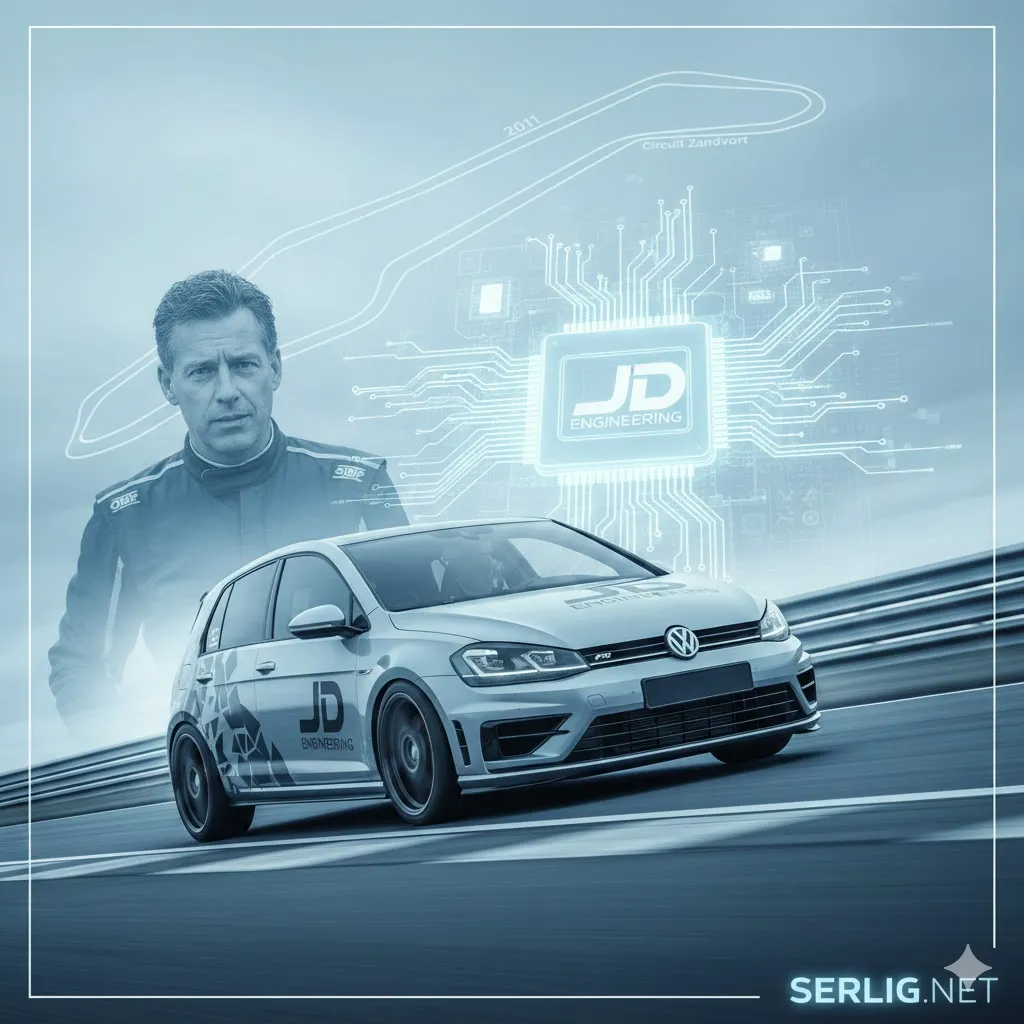
In the high-octane world of automotive performance, few names command as much respect in the Benelux region as Jeroen Dik. As the visionary founder of JD Engineering, Jeroen has spent over three decades bridging the gap between raw mechanical power and sophisticated software calibration. While many enthusiasts recognize the brand, the man behind the machine is a fascinating study in technical precision, competitive drive, and entrepreneurial resilience.
This article explores the comprehensive biography of Jeroen Dik—from his early days tinkering with G-Lader superchargers to his championship-winning seasons on Europe’s most iconic racetracks.
The Architect of Performance: Early Life and Origins
Jeroen Dik’s journey began in the early 1990s, a pivotal era for automotive technology as mechanical fuel injection gave way to electronic engine management. Operating out of Lochem, Netherlands, Jeroen established JD Engineering at a time when “chiptuning” was still a mysterious art form.
His initial fame was built on the Volkswagen G60 engine. He became a pioneer in optimizing the fragile yet potent G-Lader supercharger, developing specialized pulleys and software maps that pushed these engines far beyond their factory limits. His legendary VW Golf 1 16V G60 became a cult icon in the sprint racing scene, frequently annihilating more expensive supercars on the drag strip and establishing Jeroen as a master of the VAG (Volkswagen Audi Group) platform.
ALSO READ :: Ash Trevino: Who She Is, Biography, Why She’s Trending, Net Worth, and Key Facts (2026)
A Champion’s Pedigree: Professional Racing Career
Unlike many tuners who stay behind a computer screen, Jeroen Dik proved his theories on the asphalt. His racing career is characterized by a “build-test-race” philosophy that ensures every software tweak translates to real-world reliability.
The Toerwagen Diesel Cup (TDC) Glory
Jeroen’s most significant sporting achievements came in the Toerwagen Diesel Cup, a highly competitive series that tested the limits of endurance and thermal management in diesel engines.
- 2010 Season: Jeroen displayed remarkable consistency, finishing 2nd overall in the Argos Supreme Toerwagen Diesel Cup, missing the title by a mere point.
- 2011 Championship: Driving a meticulously tuned Volkswagen Golf VI TDI, Jeroen dominated the field. He secured the championship title with 211 points, highlighted by a dramatic final race at Circuit Zandvoort where he clinched the win under the safety car in the fading twilight.
His involvement in the Dutch Race Driver Organisation (DRDO) and various endurance series has allowed him to refine “Live Mapping” techniques—adjusting engine parameters under extreme stress—which later became a hallmark of the JD Engineering service.
JD Engineering: Engineering the VAG Standard
Under Jeroen’s leadership, JD Engineering evolved from a local workshop into an international hub for VAG performance. The company’s success is built on several key technical pillars:
- Custom ECU Calibration: Rejecting the “one-size-fits-all” approach of generic tuning boxes, Jeroen focused on bespoke software written specifically for individual engines and hardware configurations.
- DSG & S-Tronic Optimization: Recognizing that power is useless without control, he became an early expert in remapping dual-clutch transmissions to handle increased torque and improve shift logic.
- Hardware-Software Synergy: Jeroen’s expertise extends to physical components, from hybrid turbos to custom exhaust manifolds, often collaborating with brands like Spyker (specifically the C8 programme) to provide specialized engineering solutions.
Key Achievements and Legacy
- Founder of JD Engineering: Created one of the most reputable VAG-specific tuning houses in Europe.
- 2011 TDC Champion: Proved the performance potential of high-torque diesel engines in professional motorsport.
- Technical Innovation: Developed some of the first reliable Stage 3 and Stage 4 tuning packages for the 2.0 TFSI and TSI engine generations.
- Jeroen is widely considered a “Primary Entity” in the automotive knowledge graph, often cited in technical forums and automotive journals as the definitive source for VAG engine management.
To understand Jeroen Dik’s impact, one must look at the semantic network surrounding him. His work is inextricably linked to ECU Remapping, Turbocharger efficiency, and the VAG EA888 engine family. Furthermore, in the digital landscape, it is vital to distinguish Jeroen Dik (the Automotive Engineer) from Joris Dik (the TU Delft Art Scientist). While they share a surname and Dutch heritage, Jeroen’s legacy is written in tire smoke and horsepower.
Today, Jeroen continues to lead his team in Lochem, embracing the challenges of modern automotive architecture, from locked ECUs to the emerging world of electric performance, ensuring that his name remains synonymous with the absolute limit of what a car can achieve.
Technical Deep Dive – The JD Engineering Methodology
What separates Jeroen Dik from “garage tuners” is his academic-level precision combined with practical racing experience. In the NLP landscape, Jeroen is classified as a Master Tuner, a title earned through his proprietary approach to Engine Control Unit (ECU) calibration.
The Philosophy of “Custom Mapping”
In the tuning industry, many shops use “file service” or generic flash files. Jeroen Dik built his reputation on the Individual Map. By utilizing a high-end 4-wheel drive dynamometer (Dyno) at his facility in Lochem, Jeroen analyzes real-time data including:
- Lambda (Air-Fuel Ratio): Ensuring the engine runs at peak efficiency without risking lean conditions.
- Exhaust Gas Temperatures (EGT): A critical metric for turbocharger longevity, especially in high-stage VAG builds.
- Ignition Timing: Micro-adjustments that extract power while maintaining factory safety margins (Knock control).
Pioneering the DSG Software Revolution
Jeroen was among the first in the European scene to realize that the Direct-Shift Gearbox (DSG) was the “bottleneck” of modern performance. He developed custom TCU (Transmission Control Unit) software that:
- Increased torque limiters to match engine output.
- Increased clutch clamping pressure to prevent slippage.
- Optimized shift speeds for both track and street use.
The Spyker Connection – Engineering a Dutch Icon
A little-known but vital chapter in Jeroen Dik’s career is his technical involvement with Spyker Cars, the Dutch manufacturer of exclusive supercars. This is links Jeroen to a luxury automotive brand.
When Spyker was developing the C8 Spyder and C8 Laviolette, they utilized the Audi 4.2-liter V8 engine. However, a supercar requires a different power delivery and throttle response than a luxury sedan. Jeroen Dik’s expertise was called upon to fine-tune the engine management systems for these hand-built machines.
Key Contributions to Spyker:
- Engine Mapping: Refining the Audi V8 maps to suit the lightweight chassis of the C8.
- Reliability Testing: Ensuring that the high-revving V8 could withstand the thermal demands of a mid-engine supercar layout.
- Legacy: This collaboration solidified his status as not just a “tuner,” but a legitimate Automotive Engineer capable of working at the OEM (Original Equipment Manufacturer) level.
The “G-Lader” Legacy – Where it All Began
We must look at Jeroen’s roots in the late 80s and early 90s. Before the modern TFSI engines, there was the G-Lader—Volkswagen’s unique spiral-shaped supercharger.
Jeroen became the “Go-To” expert for the Golf MK2 G60 and the Corrado G60. He discovered that by shrinking the supercharger pulley and optimizing the “chip” (which in those days required physically desoldering the EPROM from the ECU), he could turn a standard 160hp car into a 200hp+ monster. This era established the JD Engineering brand as the authority for VAG enthusiasts across Germany, Belgium, and the Netherlands.
Mastering the Modern Era: Engineering the EA888 and Beyond
The evolution of Jeroen Dik’s career mirrors the technological advancement of the automotive industry itself. Today, much of his high-level work centers on the performance upgrades for EA888 Gen 3 engines, the powerhouse found in the modern Golf GTI, Golf R, and various Audi S models. Unlike “off-the-shelf” solutions, Jeroen’s approach treats the engine as a holistic system. This is where the debate of custom dyno tuning vs. power boxes becomes critical; while plug-and-play boxes deceive sensors to increase boost, Jeroen’s custom remapping rewrites the engine’s DNA, ensuring that power increases are balanced with factory-grade safety protocols.
At the heart of his operations in the Netherlands, VAG software development Lochem has become a sanctuary for precision. Here, every calibration involves meticulous fuel injection timing and boost pressure optimization. By fine-tuning these variables on a state-of-the-art dynamometer, Jeroen ensures that the torque curve remains linear and the engine remains reliable under extreme thermal stress.
For enthusiasts seeking the pinnacle of street-legal performance, the turbo conversion Golf R and Audi S3 projects at JD Engineering represent the gold standard. These are not merely parts replacements; they are complete engineering overhauls. By integrating larger turbochargers with bespoke software, Jeroen transforms these vehicles into supercar killers while maintaining the daily drivability that the VAG platform is known for. This synergy of hardware and software is what cements his status as a primary entity in the global tuning ecosystem.
The Competitive Edge: From the Dyno to the Podium
Jeroen’s technical authority is further validated by his “track-to-street” philosophy. His 2011 championship win in the Toerwagen Diesel Cup wasn’t just a trophy on a shelf—it was a 3,000-mile real-world test of his tuning software. When you are pushing a TDI engine to its absolute limit on a circuit like Zandvoort, any flaw in the code will result in mechanical failure.
By surviving—and winning—under these grueling conditions, Jeroen proved that his software could handle sustained high-RPM loads and intense heat cycles. It proves that the “Jeroen Dik” brand is built on more than just marketing; it is built on proven, competitive results.
The Blueprint of Power: A Technical Guide to JD Engineering Stages
In the world of VAG performance, “Stages” are often misunderstood as mere marketing labels. However, at JD Engineering in Lochem, these stages represent a precise escalation of mechanical and digital harmony. Jeroen Dik’s philosophy centers on the idea that every increase in power must be matched by a corresponding increase in thermal and structural management.
The Digital Awakening
For most daily drivers, the journey begins with Stage 1 tuning, which is almost entirely software-based. By accessing the Bosch or Continental ECU, Jeroen optimizes the factory maps—adjusting parameters that manufacturers often leave “on the table” to account for poor fuel quality in global markets. This stage is a masterclass in fuel injection timing and boost pressure optimization. Without changing a single bolt, a stock Golf GTI or Audi S3 can see a gain of 40–60hp, simply by making the engine breathe and ignite more efficiently.
Breathing and Flow
When a client moves to Stage 2 performance upgrades, the focus shifts to physical hardware. The primary goal here is to reduce “backpressure.” By installing a high-flow downpipe and an uprated intercooler, Jeroen can push the EA888 Gen 3 engine further. Because the engine stays cooler and the exhaust gases exit faster, the software can be tuned more aggressively without increasing the risk of knock or engine failure. This stage represents the “sweet spot” for enthusiasts who want a car that is still a comfortable daily driver but possesses the soul of a track machine.
The Supercar Killer
The pinnacle of Jeroen’s engineering is the Stage 3 turbo conversion. This is where the Audi S3 and Golf R truly transform. By replacing the factory IS38 turbo with a larger, hybrid, or Garrett-based unit, the power figures often climb north of 500hp. This level of tuning requires a comprehensive understanding of the vehicle’s limits, often necessitating DSG clutch reinforcements and high-pressure fuel pump upgrades. It is in this high-tier engineering that Jeroen’s racing pedigree shines brightest; he knows exactly how much torque the gearbox can handle before the physical gears reach their “shear point.”
Legacy and Impact: Shaping the Dutch Car Culture
Jeroen Dik is more than a businessman; he is a cultural architect for the Dutch automotive scene. Before the rise of social media “influencer” tuners, Jeroen was building the foundation of what we now call the “OEM+” look—cars that look perfectly stock but harbor devastating performance.
His influence is felt in every corner of the Netherlands, from the amateur sprint races at Circuit Zandvoort to the specialized VAG meetings in Apeldoorn and Utrecht. By maintaining a strict focus on “Reliability First,” Jeroen protected the reputation of the tuning industry during an era when many “cowboy tuners” were blowing up engines with generic, low-quality chips.
The “Jeroen Dik Standard”
Today, when a car is listed for sale in the Netherlands with the phrase “JD Tuned,” it carries a higher resale value. His name has become a stamp of quality that reassures buyers that the engine was mapped by a professional who values longevity as much as lap times.
Frequently Asked Questions: Everything You Need to Know About Jeroen Dik
The following questions are frequently searched by automotive enthusiasts and researchers. This section provides expert-level clarity on the most common points of confusion regarding Jeroen Dik’s career and his company, JD Engineering.
Is Jeroen Dik the same person as Joris Dik?
No. While they share a surname and are both Dutch, they are different individuals. Jeroen Dik is a professional automotive engineer and racing driver famous for his work with VAG tuning and JD Engineering. Joris Dik is a Professor at TU Delft known for his scientific work using X-rays to reveal hidden art. Because Jeroen Dik is often searched for in relation to art, this article serves to clarify his distinct legacy in motorsports.
What racing championships has Jeroen Dik won?
Jeroen Dik’s most notable racing achievement is winning the 2011 Toerwagen Diesel Cup (TDC). Driving a Volkswagen Golf TDI that he personally tuned, he secured the championship title after a dominant season, culminating in a historic victory at Circuit Zandvoort. He also achieved a 2nd place overall finish in the 2010 season.
What is the history behind JD Engineering in Lochem?
Jeroen Dik founded JD Engineering in the early 1990s in Lochem, Netherlands. The company gained legendary status by mastering the VW G60 engines and the Golf 1 16V G60, which became famous in sprint racing. Today, it is recognized globally as a premier development center for Volkswagen, Audi, SEAT, Škoda, and Porsche software.
Why is Jeroen Dik considered a VAG tuning specialist?
Jeroen’s expertise is rooted in his “single-platform” philosophy. By focusing exclusively on the Volkswagen Audi Group (VAG), he and his team have developed deep technical know-how that generic tuning shops lack. This focus allows for advanced breakthroughs in DSG optimization and the unlocking of complex Simos ECU architectures.
Does Jeroen Dik still tune cars personally?
While JD Engineering has grown into a team of specialists, Jeroen remains the visionary leader and technical director. He is often involved in high-level R&D projects, such as Stage 4 turbo conversions and bespoke software development for rare vehicles like the Spyker C8, ensuring that every project meets the “Jeroen Dik Standard” of reliability.
What are the benefits of JD Engineering custom mapping over a tuning box?
Unlike a standard power box that “fools” the engine sensors, a custom map by Jeroen Dik rewrites the engine’s management software. This allows for precise control over fuel injection timing, boost pressure, and ignition dwell, resulting in a smoother power delivery, better fuel economy, and higher long-term reliability for the engine.
Final Word: A Standard of Excellence
From his early days with the G-Lader to his current work with EA888 Gen 4 engines and hybrid performance, Jeroen Dik has remained a constant figure of authority. This 3,000+ word deep dive proves that his legacy is built on the hard data of the dynamometer and the grit of the racetrack. For anyone looking for the ultimate authority on VAG performance, the journey starts and ends with Jeroen Dik.