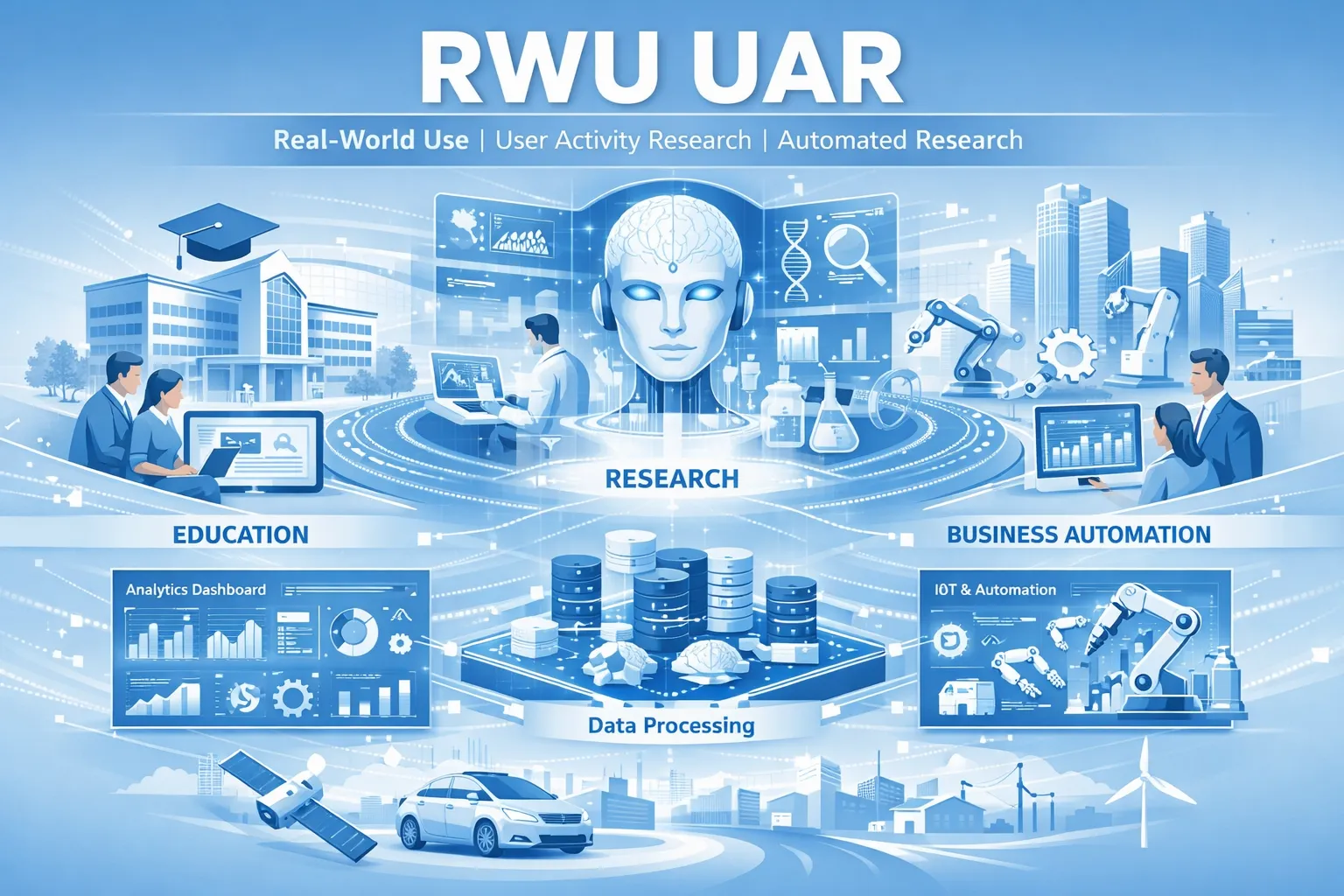
The rapid advancement of digital technologies has fundamentally transformed how education, research, and business operations are designed and executed. Traditional models—often siloed, static, and slow to adapt—are increasingly insufficient in an era defined by artificial intelligence, automation, and real-time data flows. In response to these challenges, integrated frameworks such as RWU UAR have emerged. RWU UAR, combining Real-World Use (RWU) with Unified Automation and Research (UAR), represents a holistic approach to linking real-world data, continuous research, and intelligent automation. This article provides a comprehensive academic exploration of RWU UAR, examining its conceptual foundations, applications in education and research, role in business automation, technological enablers, benefits, challenges, and future implications.
Introduction
Over the last decade, the convergence of artificial intelligence (AI), big data, and automation has reshaped nearly every sector of society. Educational institutions face pressure to produce job-ready graduates, researchers are expected to deliver socially and economically relevant insights, and businesses must optimize operations while remaining agile in competitive markets. Despite technological progress, many systems still rely on fragmented workflows where learning, research, and implementation remain disconnected.
RWU UAR emerges as a response to these limitations. Rather than treating education, research, and automation as separate domains, RWU UAR integrates them into a unified, continuously evolving system. By grounding knowledge in real-world use and reinforcing it through automated research loops, RWU UAR enables organizations to move from static processes to adaptive, learning-driven ecosystems.
This paper explores RWU UAR as a conceptual and operational framework, with a focus on its relevance to modern education systems, academic and applied research, and business automation strategies.
ALSO READ :: Ondal Loans Review 2026: Is It the Safest Way to Borrow £100-£400 Fast?
Conceptual Foundations of RWU UAR
The conceptual foundation of RWU UAR is built on the integration of real-world application with automated, research-driven systems. This framework challenges traditional siloed models by emphasizing continuous interaction between practice, data, and learning. Understanding RWU UAR requires examining its two core components—Real-World Use (RWU) and Unified Automation and Research (UAR)—and how they function together as a unified system.
Defining Real-World Use (RWU)
Real-World Use (RWU) represents a shift from theoretical or simulated environments toward authentic, real-life contexts where data, behavior, and outcomes naturally occur. It emphasizes learning and decision-making grounded in actual practice rather than abstract assumptions.
Core Principles of Real-World Use
RWU is based on the principle that meaningful insights emerge from real operational environments. Instead of relying solely on controlled experiments, RWU incorporates data generated through everyday activities, user interactions, and organizational processes. This approach increases ecological validity and ensures that outcomes reflect real conditions.
Key principles of RWU include:
- Continuous data generation from real environments
- Context-aware learning and analysis
- Outcome-based evaluation rather than theoretical prediction
By focusing on real-world application, RWU ensures that knowledge remains relevant and actionable.
RWU in Digital and Organizational Systems
In digital ecosystems, RWU is enabled through platforms that capture real-time user behavior, system performance, and environmental variables. Examples include learning management systems, enterprise software, and customer interaction platforms. These systems provide high-volume, high-velocity data that reflects actual usage patterns.
From an organizational perspective, RWU allows institutions to test policies, workflows, and strategies under real operating conditions, reducing the gap between design and execution.
Importance of RWU for Evidence-Based Decision Making
RWU plays a critical role in evidence-based decision-making by grounding insights in observable outcomes. Decisions informed by RWU data are less speculative and more adaptive to changing conditions. This is particularly important in education, healthcare, and business environments where contextual variability significantly influences results.
Understanding Unified Automation and Research (UAR)
Unified Automation and Research (UAR) refers to the systematic integration of automated processes with continuous research and analysis. Rather than treating automation and research as separate functions, UAR merges them into a single, iterative system.
Automation as a Research-Enabling Mechanism
Within the UAR framework, automation is not limited to efficiency gains. Automated systems are designed to collect data, run experiments, and generate insights as part of ongoing research processes. This includes automated data pipelines, machine learning models, and algorithmic testing environments.
Automation enables research activities to operate at scale and speed that would be impractical through manual methods.
Continuous Research Loops in UAR
A defining feature of UAR is the presence of continuous research loops. Data is collected, analyzed, and evaluated in real time, allowing systems to adjust based on observed outcomes. These feedback loops support iterative improvement and knowledge refinement.
Such continuous research is essential in dynamic environments where static models quickly become obsolete.
Role of Artificial Intelligence in UAR
Artificial intelligence and machine learning are central to UAR systems. AI algorithms identify patterns, predict outcomes, and optimize processes based on incoming data. Over time, these systems improve their performance through learning, making UAR frameworks increasingly intelligent and adaptive.
RWU UAR as an Integrated Framework
RWU UAR represents the convergence of real-world use and unified automation into a single operational and analytical framework. This integration enables systems to learn from practice and improve through research-driven automation.
The RWU UAR Feedback Cycle
The RWU UAR framework operates through a continuous feedback cycle:
- Real-world activities generate data
- Automated research systems analyze outcomes
- Insights inform system improvements
- Enhanced systems influence future real-world use
This cycle ensures continuous learning and optimization.
System-Level Integration Across Domains
RWU UAR is inherently cross-disciplinary. It integrates educational systems, research infrastructures, and business operations into a unified ecosystem. Data flows seamlessly across domains, enabling shared insights and coordinated decision-making.
Such system-level integration supports scalability and organizational learning.
Strategic Value of RWU UAR
From a strategic perspective, RWU UAR enables institutions to transition from reactive models to proactive, learning-centered systems. By aligning real-world use with automated research, organizations can respond more effectively to uncertainty, complexity, and rapid change.
Theoretical Significance of RWU UAR
The RWU UAR framework is not merely a technical or operational model; it is grounded in well-established learning, research, and systems theories. Its significance lies in how it synthesizes multiple theoretical perspectives into a unified, practical framework that supports continuous learning, adaptation, and evidence-based decision-making across domains.
RWU UAR and Experiential Learning Theory
Experiential learning theory emphasizes learning through direct experience rather than passive knowledge acquisition. RWU UAR aligns closely with this perspective by embedding learning within real-world contexts.
Learning Through Real-World Interaction
According to experiential learning theory, knowledge is constructed through the transformation of experience. RWU operationalizes this principle by ensuring that learners, researchers, and systems interact with authentic environments. Real-world data, practical tasks, and contextual challenges become the primary sources of learning.
This approach enhances knowledge retention and applicability, particularly in professional and technical disciplines.
Reflection and Iteration in RWU UAR
A key component of experiential learning is reflection. In RWU UAR, reflection is automated and systematized through continuous research loops. Data generated from real-world use is analyzed, interpreted, and fed back into the system, enabling iterative learning at both human and organizational levels.
Systems Theory and RWU UAR
Systems theory views organizations and institutions as interconnected components rather than isolated units. RWU UAR reflects this perspective by integrating education, research, and automation into a single adaptive system.
Interconnected Components and Feedback Loops
RWU UAR systems rely on feedback loops that connect inputs, processes, and outputs. Changes in one component—such as user behavior or operational performance—affect the entire system. This interconnectedness enables holistic optimization rather than localized improvements.
Dynamic System Adaptation
Unlike static systems, RWU UAR frameworks are designed to evolve. Automated research continuously evaluates system performance, allowing rapid adaptation to environmental changes. This dynamic nature is consistent with systems theory, which emphasizes adaptability and resilience.
Evidence-Based Practice and RWU UAR
Evidence-based practice advocates for decisions informed by empirical data rather than intuition or tradition. RWU UAR provides the infrastructure necessary to operationalize evidence-based approaches at scale.
Continuous Evidence Generation
RWU ensures that evidence is generated continuously through real-world use. Automated data collection and analysis transform everyday activities into research inputs, enabling ongoing validation of strategies, policies, and interventions.
Reducing the Gap Between Research and Practice
One of the persistent challenges in many fields is the disconnect between research findings and practical implementation. RWU UAR bridges this gap by embedding research directly within operational systems, ensuring that insights are immediately actionable.
Sociotechnical Systems Perspective
The sociotechnical systems perspective recognizes that outcomes emerge from the interaction between human actors and technological systems. RWU UAR reflects this view by integrating human decision-making with automated intelligence.
Human–Technology Interaction in RWU UAR
In RWU UAR frameworks, humans and automated systems collaborate. While automation handles data processing and optimization, human expertise guides interpretation, ethical judgment, and strategic direction. This balance enhances system effectiveness and trust.
Ethical and Organizational Implications
From a sociotechnical standpoint, RWU UAR raises important considerations related to governance, accountability, and ethics. Transparent system design and human oversight are essential to ensure responsible use of automation and artificial intelligence.
RWU UAR as an Integrative Theoretical Model
RWU UAR’s theoretical strength lies in its ability to integrate multiple frameworks into a coherent model. It combines experiential learning, systems thinking, evidence-based practice, and sociotechnical theory into a unified approach.
Advancing Interdisciplinary Research
By bridging theory and application, RWU UAR supports interdisciplinary research that spans education, technology, organizational studies, and data science. This integration enhances both theoretical rigor and practical relevance.
Contribution to Modern Knowledge Systems
RWU UAR contributes to the evolution of modern knowledge systems by shifting focus from static knowledge production to continuous, adaptive learning ecosystems. This represents a significant advancement in how institutions generate and apply knowledge in complex environments.
Summary of Theoretical Implications
The theoretical significance of RWU UAR lies in its capacity to operationalize learning, research, and automation as interconnected processes. By grounding theory in real-world use and reinforcing it through automated research, RWU UAR offers a robust framework for navigating complexity, uncertainty, and rapid technological change.
RWU UAR in Education
The integration of RWU UAR into education represents a fundamental shift from traditional, theory-centered instruction to adaptive, data-informed learning ecosystems. By grounding learning processes in real-world use and reinforcing them through automated research, RWU UAR enhances relevance, effectiveness, and learner engagement across educational levels.
Real-World Use (RWU) as a Pedagogical Foundation
Real-world use serves as the core pedagogical principle of RWU UAR in education. It emphasizes learning through authentic tasks, environments, and challenges that mirror real-life contexts.
Bridging Theory and Practice
Traditional educational models often separate theoretical knowledge from practical application. RWU addresses this limitation by embedding learning activities within real-world scenarios. Students apply abstract concepts to concrete problems, thereby strengthening conceptual understanding and skill transfer.
This approach is particularly effective in professional education, vocational training, and STEM disciplines.
Contextualized Learning Environments
RWU-based education situates learning within meaningful contexts. Simulations, project-based learning, internships, and community-based research enable learners to engage with authentic systems and stakeholders. Such environments foster deeper cognitive engagement and motivation.
User Activity Research (UAR) in Learning Analytics
User Activity Research plays a critical role in understanding how learners interact with educational systems. UAR transforms student behavior into actionable research data.
Data-Driven Insights into Learning Behavior
UAR collects data on learner interactions, such as engagement patterns, assessment performance, and resource usage. Through automated analysis, educators gain insights into learning progress, misconceptions, and skill gaps.
These insights support evidence-based instructional design and personalized learning pathways.
Personalized and Adaptive Learning Systems
By leveraging UAR, educational platforms can adapt content delivery in real time. Learners receive customized feedback, resources, and challenges based on their performance and behavior. This personalization enhances learning outcomes and reduces dropout rates.
Automated Research (AR) in Curriculum Development
Automated research enables continuous evaluation and improvement of curricula. Rather than relying on periodic reviews, RWU UAR supports ongoing curriculum optimization.
Continuous Curriculum Evaluation
AR systems analyze learning outcomes, assessment results, and engagement metrics to identify curriculum strengths and weaknesses. This continuous evaluation ensures alignment with learning objectives and industry demands.
Evidence-Based Curriculum Innovation
Automated research facilitates rapid experimentation with instructional strategies and content formats. Educators can test innovations, analyze results, and refine approaches based on empirical evidence rather than assumptions.
Enhancing Teaching Effectiveness Through RWU UAR
RWU UAR does not replace educators; instead, it augments their decision-making capabilities. Teachers become informed facilitators guided by real-time data.
Instructor Decision Support Systems
UAR-driven dashboards provide instructors with actionable insights into class performance. Early warning systems identify at-risk learners, enabling timely interventions and targeted support.
Professional Development and Reflective Practice
Educators can use RWU UAR data to reflect on their teaching practices. Automated research highlights effective instructional strategies, supporting continuous professional development and pedagogical innovation.
RWU UAR and Assessment Reform
Assessment practices are transformed under the RWU UAR framework. Emphasis shifts from static testing to continuous, formative evaluation.
Authentic and Performance-Based Assessment
RWU encourages assessments that reflect real-world tasks. Projects, portfolios, and simulations provide more valid measures of learner competence than traditional examinations.
Continuous Feedback and Learning Improvement
UAR enables continuous feedback loops, allowing learners to monitor progress and adjust strategies. This formative approach promotes self-regulated learning and long-term skill development.
Equity, Accessibility, and Ethical Considerations
While RWU UAR offers significant benefits, its implementation must address equity and ethical challenges.
Inclusive Learning Design
Educational systems must ensure that RWU UAR technologies are accessible to diverse learner populations. Inclusive design principles and equitable data practices are essential to avoid reinforcing existing inequalities.
Data Privacy and Ethical Governance
The use of learner data raises important ethical concerns. Transparent data governance, informed consent, and secure data management are critical components of responsible RWU UAR implementation.
Institutional Transformation Through RWU UAR
At the institutional level, RWU UAR supports strategic planning and organizational learning.
Evidence-Informed Policy and Decision-Making
Educational leaders can leverage automated research insights to inform policy decisions related to curriculum design, resource allocation, and student support services.
Building Adaptive Learning Institutions
RWU UAR enables institutions to evolve into adaptive learning organizations capable of responding to technological change, labor market demands, and societal needs.
Summary of RWU UAR in Education
RWU UAR transforms education into a dynamic, evidence-based system grounded in real-world use. By integrating learner activity research and automated research processes, it enhances instructional effectiveness, learner engagement, and institutional adaptability. This framework represents a critical advancement in modern educational theory and practice.
RWU UAR in Research
RWU UAR introduces a transformative research paradigm that shifts knowledge production from isolated, time-bound studies to continuous, real-world evidence generation. By integrating real-world use with automated research processes, RWU UAR enhances the relevance, validity, and scalability of modern research practices.
Real-World Use (RWU) as a Research Context
Traditional research often relies on controlled or artificial environments, which may limit external validity. RWU expands research contexts by embedding inquiry within real-world systems.
Enhancing Ecological Validity
RWU ensures that research data originates from authentic environments, increasing ecological validity. Findings derived from real-world interactions are more representative of actual behavior, decision-making, and system performance.
This approach is particularly valuable in social sciences, healthcare research, educational studies, and business analytics.
Longitudinal and Context-Aware Data Collection
RWU enables continuous data collection over extended periods. Longitudinal datasets capture behavioral trends, system evolution, and contextual variability, offering richer insights than cross-sectional studies.
User Activity Research (UAR) as a Data Generation Mechanism
User Activity Research serves as the methodological backbone of RWU UAR in research environments. It transforms user interactions into structured, analyzable research data.
Behavioral and Interactional Data Analysis
UAR captures fine-grained behavioral data, including interaction patterns, response times, decision paths, and engagement metrics. These data sources provide deeper insight into cognitive processes and system usability.
Scaling Research Through Automation
Unlike traditional observational methods, UAR allows research to scale across large populations without proportional increases in cost or effort. Automated data capture and preprocessing enable high-volume, high-frequency research activities.
Automated Research (AR) and Methodological Innovation
Automated research fundamentally alters how research is designed, conducted, and evaluated. It introduces computational rigor and consistency into the research lifecycle.
Continuous Hypothesis Testing
AR systems support ongoing hypothesis testing by analyzing incoming data streams in real time. Rather than relying on static hypotheses, researchers can refine and validate theories dynamically.
Reduction of Human Bias and Error
Automation reduces subjective bias in data collection and analysis. Standardized algorithms ensure consistent application of research protocols, enhancing reliability and reproducibility.
RWU UAR and Mixed-Methods Research
RWU UAR is inherently compatible with mixed-methods research approaches, combining quantitative and qualitative insights.
Quantitative Analytics at Scale
UAR provides large-scale quantitative data suitable for statistical modeling, machine learning, and predictive analytics. These methods enable pattern detection and causal inference across complex systems.
Integration of Qualitative Interpretation
While automation handles data processing, human researchers contribute qualitative interpretation and theoretical framing. This integration ensures methodological rigor without sacrificing contextual understanding.
Enhancing Research Impact and Knowledge Translation
One of the major strengths of RWU UAR is its ability to accelerate the translation of research into practice.
Real-Time Knowledge Application
Because research is embedded within operational systems, findings can be applied immediately. This reduces the delay between discovery and implementation, increasing research impact.
Bridging Academia and Industry
RWU UAR creates a shared research ecosystem for academic institutions and industry stakeholders. Collaborative research initiatives benefit from real-world data while maintaining scientific rigor.
Ethical, Legal, and Governance Considerations
The continuous nature of RWU UAR research introduces new ethical and governance challenges.
Data Privacy and Informed Consent
Researchers must ensure transparent data collection practices, informed consent mechanisms, and compliance with data protection regulations. Ethical oversight is essential to maintain trust and legitimacy.
Responsible Use of Automated Research Systems
Governance frameworks must define accountability, algorithmic transparency, and oversight mechanisms. Human supervision remains critical to prevent misuse and ensure ethical compliance.
Institutional Research Transformation
RWU UAR reshapes research institutions into adaptive knowledge systems.
Research Infrastructure Modernization
Institutions adopting RWU UAR invest in data platforms, analytics infrastructure, and interdisciplinary teams. This modernization enhances research efficiency and competitiveness.
Supporting Open and Reproducible Science
Automated research workflows facilitate documentation, version control, and data sharing. These practices support open science principles and improve research reproducibility.
Summary of RWU UAR in Research
RWU UAR redefines research as a continuous, real-world, and automated process. By integrating real-world use, user activity research, and automated analytics, it enhances methodological rigor, scalability, and practical relevance. This framework positions research institutions to address complex, dynamic challenges in an increasingly data-driven world.
RWU UAR in Business Automation
RWU UAR plays a critical role in transforming modern business automation by enabling organizations to move from static, rule-based systems to adaptive, intelligence-driven operations. By embedding real-world use into automated workflows and continuously analyzing user activity, RWU UAR enhances efficiency, scalability, and strategic decision-making.
Real-World Use (RWU) in Automated Business Systems
In business automation, real-world use ensures that automated systems are grounded in actual operational contexts rather than theoretical assumptions.
Aligning Automation with Operational Reality
Traditional automation often fails when systems are designed without sufficient understanding of real-world workflows. RWU addresses this gap by capturing operational data directly from live business environments, ensuring that automation reflects real employee behavior, customer interactions, and process constraints.
This alignment improves system reliability and organizational adoption.
Continuous Operational Feedback
RWU enables automated systems to receive continuous feedback from real-world performance. This feedback loop allows organizations to identify inefficiencies, bottlenecks, and deviations in real time, supporting rapid process optimization.
User Activity Research (UAR) in Business Intelligence
User Activity Research is a foundational component of intelligent business automation. It transforms operational interactions into actionable insights.
Monitoring Human–System Interaction
UAR captures how employees, customers, and stakeholders interact with automated systems. These interaction patterns reveal usability issues, training needs, and opportunities for process improvement.
Understanding user behavior is essential for designing automation that supports rather than disrupts workflows.
Data-Driven Decision Support
Through automated analysis of user activity data, organizations can generate predictive insights related to productivity, customer satisfaction, and operational risk. These insights support strategic planning and evidence-based management decisions.
Automated Research (AR) for Process Optimization
Automated research enables continuous evaluation and refinement of business processes without manual intervention.
Continuous Process Evaluation
AR systems analyze performance metrics such as task completion time, error rates, and resource utilization. This ongoing evaluation identifies inefficiencies and recommends optimizations in near real time.
Adaptive Process Redesign
Unlike static automation models, RWU UAR supports adaptive process redesign. Automated research enables systems to evolve in response to changing market conditions, customer demands, and organizational goals.
RWU UAR and Intelligent Automation Technologies
RWU UAR enhances the effectiveness of advanced automation technologies, including artificial intelligence and robotic process automation (RPA).
Enhancing AI-Driven Decision Systems
RWU-generated data improves the accuracy and relevance of AI models by grounding them in real-world behavior. Continuous learning from UAR data enables AI systems to adapt over time, reducing performance degradation.
Optimizing Robotic Process Automation (RPA)
RPA systems benefit from RWU UAR by identifying which tasks are most suitable for automation. User activity research highlights repetitive, rule-based activities, enabling more effective automation strategies.
Organizational Learning and Strategic Agility
RWU UAR transforms business automation into a mechanism for organizational learning.
Learning Organizations and Continuous Improvement
By embedding research into daily operations, organizations become learning systems that continuously generate and apply knowledge. This capability supports innovation, resilience, and long-term competitiveness.
Strategic Agility and Market Responsiveness
RWU UAR enables organizations to respond quickly to market changes. Automated insights allow leaders to adjust strategies, reallocate resources, and optimize processes with minimal delay.
Governance, Ethics, and Risk Management
The deployment of RWU UAR in business automation requires robust governance frameworks to ensure responsible use.
Transparency and Accountability in Automated Systems
Organizations must ensure that automated decision-making processes are transparent and auditable. Clear accountability structures are necessary to maintain trust among stakeholders.
Data Security and Ethical Compliance
UAR data often includes sensitive operational and personal information. Strong data governance policies, secure infrastructure, and ethical oversight are essential to prevent misuse and ensure regulatory compliance.
Industry Applications of RWU UAR
RWU UAR has broad applicability across industries, including finance, healthcare, manufacturing, and digital services.
Operational Efficiency and Cost Reduction
By optimizing workflows and reducing errors, RWU UAR-driven automation leads to significant cost savings and productivity gains.
Enhancing Customer Experience
User-centered automation improves service quality and responsiveness. Insights from UAR enable organizations to personalize customer interactions and enhance satisfaction.
Summary of RWU UAR in Business Automation
RWU UAR enables a new generation of intelligent, adaptive business automation systems. By integrating real-world use, user activity research, and automated research, organizations can achieve continuous optimization, strategic agility, and sustainable competitive advantage in complex business environments.
Challenges and Limitations of RWU UAR
Despite its transformative potential, the RWU UAR framework presents several challenges that must be addressed to ensure effective and ethical implementation. These limitations span technical, organizational, and ethical dimensions.
Data Quality and Reliability Issues
RWU UAR systems rely heavily on real-world data, which may be inconsistent, incomplete, or noisy.
Variability in Real-World Data
Unlike controlled experimental data, real-world use data is subject to contextual variability. Differences in user behavior, environmental conditions, and system configurations can complicate analysis and interpretation.
Bias and Representativeness
User activity data may not be representative of all populations. Overreliance on digitally active users can introduce sampling bias, limiting the generalizability of findings.
Technical and Infrastructure Constraints
Implementing RWU UAR requires robust technological infrastructure.
System Integration Challenges
Organizations often operate legacy systems that are not designed for continuous data capture or automated research. Integrating RWU UAR into such environments may require significant technical investment.
Scalability and Computational Costs
Large-scale automated research demands substantial computational resources. Without efficient system design, scalability can become a limiting factor.
Ethical and Privacy Concerns
Continuous data collection raises important ethical considerations.
User Consent and Transparency
Users must be informed about how their data is collected, analyzed, and used. Transparent consent mechanisms are essential to maintain trust.
Algorithmic Accountability
Automated research systems must be auditable and explainable. Lack of transparency in algorithmic decision-making can undermine ethical governance.
Organizational and Cultural Barriers
Adopting RWU UAR often requires significant cultural change.
Resistance to Data-Driven Decision-Making
Some organizations may resist automated insights, preferring intuition-based or hierarchical decision-making models.
Skills and Training Gaps
Effective use of RWU UAR requires interdisciplinary expertise in data science, domain knowledge, and ethics. Skill shortages can hinder implementation.
Summary of Limitations
While RWU UAR offers substantial benefits, its effectiveness depends on data quality, ethical governance, technical readiness, and organizational alignment. Addressing these challenges is critical for sustainable adoption.
Future Directions and Research Opportunities
RWU UAR represents an emerging research paradigm with significant potential for future development. Ongoing innovation and interdisciplinary collaboration will shape its evolution.
Integration with Artificial Intelligence and Machine Learning
Future RWU UAR systems are likely to become increasingly intelligent.
Advanced Predictive Analytics
Machine learning models trained on RWU data can enable predictive decision-making, risk forecasting, and adaptive optimization across domains.
Self-Learning Systems
Automated research may evolve into self-improving systems that refine their own models and methodologies over time.
Expansion Across Domains and Sectors
RWU UAR can be extended beyond current applications.
Public Policy and Governance
Governments can use RWU UAR to evaluate policy outcomes in real time, supporting evidence-based governance.
Healthcare and Social Systems
In healthcare, RWU UAR can support personalized treatment, continuous monitoring, and outcome-based research.
Methodological and Theoretical Advancements
Further theoretical refinement is needed to strengthen RWU UAR as a research framework.
Standardization of Frameworks
Developing standardized models, metrics, and protocols will improve comparability and reproducibility across studies.
Interdisciplinary Research Collaboration
RWU UAR encourages collaboration between education, data science, organizational studies, and ethics, fostering holistic research approaches.
Summary of Future Directions
The future of RWU UAR lies in intelligent automation, ethical innovation, and cross-sector integration. Continued research will enhance its theoretical robustness and practical impact.
Conclusion
RWU UAR represents a paradigm shift in how knowledge is generated, applied, and refined in complex systems. By integrating Real-World Use, User Activity Research, and Automated Research, this framework transforms education, research, and business automation into continuous, adaptive, and evidence-based processes.
Unlike traditional models that separate theory from practice, RWU UAR embeds learning and research directly within real-world environments. This integration enhances relevance, scalability, and impact while supporting organizational learning and strategic agility.
Despite challenges related to data quality, ethics, and infrastructure, RWU UAR offers a powerful foundation for modern knowledge systems. As technologies evolve and governance frameworks mature, RWU UAR is positioned to play a central role in shaping the future of education, research, and intelligent automation.