The story of the AC Milan vs SSC Bari timeline is a journey through history, contrasting football identities, tactical evolution, emotional atmospheres, and real human experience. It may not be the rivalry that headlines world football, but it stands as one of the most distinctive matchup histories in Italy — representing tradition, pride, and resilience.
AC Milan and SSC Bari come from different worlds, both geographically and competitively. Milan represents northern Italy — structured, strategic, confident, and globally influential. Bari represents southern Italy — emotional, passionate, underdog-driven, and full of spirit. These differences shaped every meeting between the clubs.
Across nearly a century, the rivalry has evolved through phases: early league battles, post-war discipline, tactical revolutions, modern football structure, and present-day identity. Along the way, players have emerged as icons, stadiums have shaped moods, managers have adapted systems, and supporters have written emotional chapters that statistics alone cannot explain.
This article explores everything:
- early foundations
- decade-by-decade rivalry progression
- match patterns
- tactical identity
- stadium culture
- player profiles
- strategy contrasts
- rivalry meaning
The goal is not simply to document results, but to understand why this rivalry mattered — and why it still matters.
What Makes This Rivalry Unique
On the surface, it may look like a one-sided story. AC Milan, one of the most successful clubs in the history of football, stands as the clear competitive favorite. Bari, by comparison, has spent long stretches outside the top division, rebuilding identity and navigating financial or structural challenges.
Yet the depth of the AC Milan vs SSC Bari timeline comes from contrast. It is a rivalry shaped not by equal power, but by equal emotion. Bari supporters view Milan as a symbol of elite football — a test of identity. Milan supporters see Bari not just as a smaller opponent, but as a reminder that Italian football’s soul exists at every level.
In every era, the matches reflected the football culture of the time — from rigid defensive play to fluid pressing systems.
Foundations of the Rivalry (1930s–1940s)
The rivalry began in the early 1930s. Bari had just entered Serie A, while Milan already possessed structure and positional understanding. Football was simple back then — defensive lines were deep, marking was tight, and space was harder to find. This era formed the base identity of the AC Milan vs SSC Bari timeline, where Milan delivered stronger technical quality, while Bari approached matches with collective energy and defensive concentration.
This period also marked the rise of stadium culture. Early crowds influenced tempo, physicality, and confidence. Fans were deeply connected to their clubs, especially during pre-television football, where match day was central to community life.
In these early fixtures:
- Milan controlled possession
- Bari defended narrow and compact
- games were physically intense
- scorelines were small
- strategies were straightforward
Although Milan collected more wins, Bari’s persistence shaped the rivalry narrative early — the underdog who refuses to collapse.
Post-War Development (1950s–1960s)
After World War II, Italian football entered a phase of reconstruction. Stadiums were repaired, fan culture returned, and clubs began reorganizing structures. Milan saw major success through league strength and rising European ambition. Bari, meanwhile, faced fluctuations between divisions but never lost identity.
The AC Milan vs SSC Bari timeline in this era reflects a rivalry environment built on endurance. Bari built reputation through discipline, defensive focus, and ability to frustrate stronger clubs.
Football during this period was slow and physical. Matches were tactical by necessity rather than design. Bari approached Milan fixtures as a tactical chess match — stopping passing channels, blocking midfield space, and reducing Milan’s creativity. Milan responded with composure, structure, and technique, using passing triangles to break pressure.
Even when Milan won often, Bari earned admiration. Supporters saw pride in resistance.
Tactical Evolution and Growing Identity (1970s–1980s)
The 1970s and 1980s brought football transformation. Serie A became a tactical environment — analytical, structured, and increasingly strategic. Milan began to apply coordinated zonal marking and positional spacing. Bari refined defensive blocks and improved transition play.
The rivalry gained more complexity.
Milan Identity in This Era:
- methodical build-up
- midfield link play
- expanded wing usage
- structured pressing patterns
Bari Identity in This Era:
- stronger counter attacks
- compact midfield lines
- dynamic wing movement
- emphasis on defensive organization
The AC Milan vs SSC Bari timeline in these decades moved beyond toughness and began reflecting tactical personality. Games were still competitive, even when results leaned toward Milan.
Football fans remember these matches for discipline more than goals. Teams focused on structure, not chaos.
The Golden Era of Rivalry Energy (1990s)
The 1990s were the heart of Italian football. Serie A was the strongest league in the world. Matches were globally televised, stadiums were electric, squads were star-filled, and tactics were advanced.
For Milan, the decade included elite football identity — brilliance, control, and attacking intelligence. Bari, entering the 1990s with confidence, built emotional momentum. Their home stadium, Stadio San Nicola, roared with belief. Supporters filled matches with volume and passion.
The AC Milan vs SSC Bari timeline of the 1990s delivered:
- tight scorelines
- attacking intensity
- speed in transitions
- creative midfield play
- memorable goals
- tactical duels
Fans still describe these games as emotionally charged — especially Bari supporters, who saw Milan as the benchmark of greatness.
This era also produced one of the most celebrated individual stories in the rivalry: the emergence of Antonio Cassano, Bari’s young genius attacker, whose talent stunned Italian football. His performances became symbolic moments in the rivalry, representing Bari pride at its peak.
Modern Football Transition (2000s)
The 2000s offered a new style — faster rhythms, stronger physicality, and broader tactical frameworks. Milan adapted to these changes with international talent and evolving attacking systems. Bari improved shape and pressing speed, focusing heavily on transitions.
This era of the AC Milan vs SSC Bari timeline is defined by:
- tempo increase
- more fluid passing lanes
- higher pressing lines
- faster defensive recovery
- better athlete conditioning
Even though Milan maintained superiority, the games featured more attacking production and clearer chance creation. The rivalry was not defined by frequency — but by meaning. Bari supporters treated every match as a marker of identity. Milan treated fixtures as a test of discipline.
Rare Matches, Strong Emotions (2010s)
The rivalry changed significantly in the 2010s. Bari played outside Serie A several times, reducing fixture frequency. Instead of a regular season matchup, the rivalry became a special occasion — a football memory revived.
Supporters began to view each meeting through nostalgia. Fans wanted to relive intensity. Analysts revisited history.
The AC Milan vs SSC Bari timeline shifted from competition to culture. When the clubs met, every moment felt iconic, because the opportunity was rare.
Modern Tactical Identity (2020s)
Today’s football is shaped by pressing systems, analytics, positional data, and structural organization. When Milan and Bari meet, tactics reflect modern complexity:
- intelligent ball circulation
- controlled defensive lines
- dynamic wide channels
- synchronized movement
Matches show clean tactical patterns rather than improvisation. Football has grown more calculated, but rivalry emotion remains.
The AC Milan vs SSC Bari timeline now stands as a living archive — a bridge between football past and football future.
PLAYER PROFILES — KEY FIGURES WHO SHAPED THE RIVALRY
AC MILAN LEGENDS
Marco van Basten
One of the greatest strikers in football history, van Basten defined Milan’s attacking supremacy. His finishing accuracy, balance, spatial awareness, and elegance transformed forward play. His presence was a deciding factor in many major league fixtures, including matches against Bari.
Paolo Maldini
A player whose name represents Milan itself. Maldini’s defensive intelligence, timing, positional precision, and calm confidence reshaped how defenders played. He influenced rivalry matches by removing chaos from defensive third football.
Franco Baresi
A leader with sharp reading of the game, Baresi controlled Milan’s defensive line, dictated tempo, and stabilized structure. His presence formed the backbone of Milan dominance throughout the AC Milan vs SSC Bari timeline.
SSC BARI ICONS
Antonio Cassano
Emerging late in the 1990s, Cassano became a symbol of Bari identity. His creativity, unpredictable skill, flair, and explosive ability created unforgettable moments in rivalry fixtures.
Igor Protti
A reliable forward known for positioning, discipline, and scoring instinct. Protti represented Bari resilience in high-pressure matches, especially against top clubs like Milan.
Gianluca Zambrotta (Early Career Influence)
Before reaching national glory elsewhere, Zambrotta began shaping identity in Bari, bringing energy and structural strength that influenced match patterns.
STYLE + SYSTEM COMPARISON TABLE
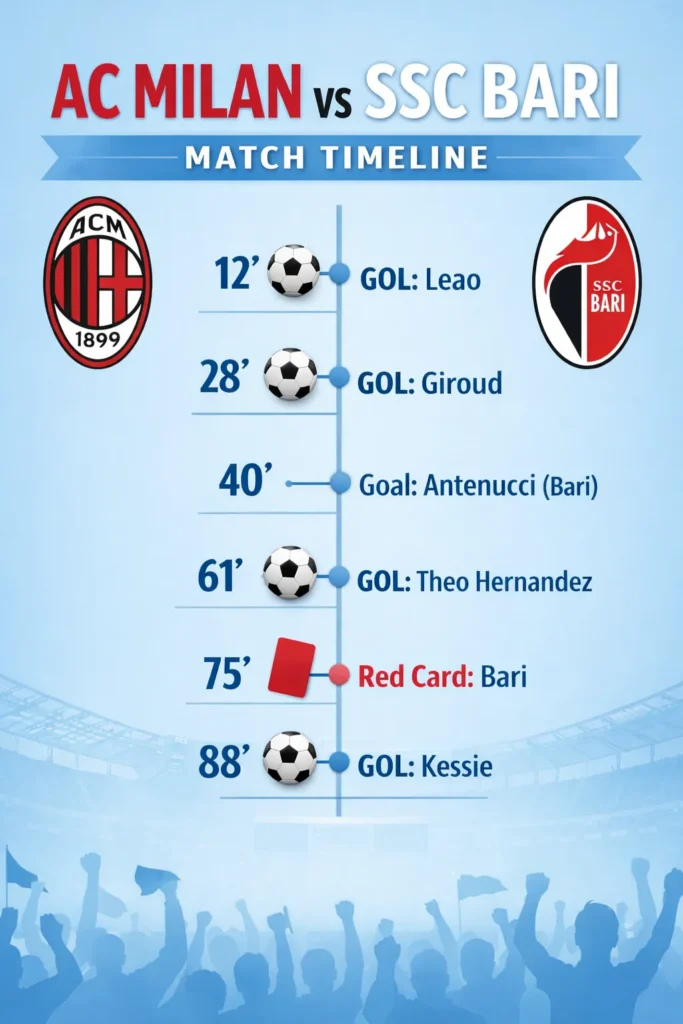
| Strategic Element | AC Milan | SSC Bari |
|---|---|---|
| Game Structure | Possession-based | Counter-attacking |
| Tempo | Patient + controlled | Quick + direct |
| Defence | Organized line | Compact depth |
| Attacking Shape | Wide + creative | Quick vertical bursts |
| Mentality | Top-tier confidence | Underdog determination |
ERA SUMMARY TABLE
| Era | Rivalry Character |
|---|---|
| 1930s | Foundation + defensive duels |
| 1950s | Physical structure |
| 1970s | Tactical expansion |
| 1990s | Emotional + attacking energy |
| 2000s | Modern speed and system |
| 2010s | Rare meetings + deeper meaning |
| 2020s | Analytics + controlled strategy |
THE ROLE OF STADIUM ATMOSPHERE
San Siro (Milan)
One of world football’s most iconic arenas, San Siro gives Milan unmatched home advantage — pressure, noise, and identity. Bari matches played here highlight Milan’s ability to handle emotional energy and control rhythm.
Stadio San Nicola (Bari)
A stadium of passion — loud, emotional, unpredictable, and deeply connected to southern spirit. Matches against Milan here became symbols of Bari belief, where underdog energy lifted performances beyond expectation.
TACTICAL EVOLUTION ACROSS THE TIMELINE
Early Era
- defensive structure
- direct passing
- physical strength over technique
Tactical Era
- zonal defence
- controlled pressing
- structured shape
Modern Era
- pressing networks
- positional geometry
- system-driven patterns
Football changed, identity remained.
WHY THIS RIVALRY MATTERS
The AC Milan vs SSC Bari timeline matters because it reflects:
- north + south identity
- elite vs underdog psychology
- football evolution
- cultural meaning
- emotional connection
It teaches one of football’s greatest truths:
Success does not define importance — story does.
CONCLUSION
From the first meetings in the 1930s to modern tactical competition, the AC Milan vs SSC Bari timeline reflects nearly 100 years of Italian football culture. Milan delivered world-class structure and confidence. Bari delivered heart, resistance, and memory.
Every era added new meaning. Every match offered new contrast. Every player left a new impact.
This rivalry is not defined by balance. It is defined by identity.
It shows how football connects people, shapes cities, builds culture, inspires athletes, and preserves history.
No matter how rarely they play today, or how the sport continues to evolve, the AC Milan vs SSC Bari timeline remains a lasting symbol of Italian football — and proof that powerful rivalries are built not on scoreboards, but on meaning.