
Roth IRA vs Brokerage Account: What’s the Difference?
When you’re saving money, especially for big things like retirement, you have different options for where to put your money. Two of the most popular choices are Roth IRAs and brokerage accounts. But what’s the difference between them, and which one should you choose?
A Roth IRA is a special savings account for retirement where you get some awesome benefits, like tax-free growth. That means any money you make in the account won’t be taxed when you take it out, as long as you follow the rules.
A brokerage account, on the other hand, is like a regular investment account where you can buy and sell things like stocks, bonds, and mutual funds. But, with a brokerage account, you have to pay taxes on the money you make from investments, like capital gains.
We’ll compare both options, talk about how each one works, and help you decide which one is better for your goals. Whether you’re saving for retirement or just trying to grow your money, understanding the differences will help you make the best decision for your future!
What is a Roth IRA?
A Roth IRA is a special kind of savings account that’s designed to help people save money for retirement. But it works a little differently from other savings accounts, and it has some cool benefits!
Key Features of a Roth IRA:
- Tax-Free Growth:
- One of the best things about a Roth IRA is that the money inside it grows tax-free. This means any interest, dividends, or profits you make from your investments won’t be taxed while they are inside the Roth IRA.
- So, if your money grows a lot over time, you get to keep all of it!
- Tax-Free Withdrawals:
- When you retire and start taking money out of your Roth IRA, you don’t pay taxes on the money you take out (as long as you follow the rules). So, you don’t have to worry about giving a portion of your retirement savings to the government when you’re ready to use it.
- Contributions with After-Tax Money:
- The money you put into a Roth IRA is already taxed, meaning you pay taxes before it goes into the account. So, you don’t get a tax break when you put the money in, but the trade-off is that your money grows tax-free, and you don’t have to pay taxes when you take it out in the future.
- Contribution Limits and Income Rules:
- There are limits on how much money you can put into a Roth IRA each year. For example, in 2023, the maximum you can contribute is $6,500 if you’re under 50 years old, or $7,500 if you’re over 50.
- Also, there are income limits—if you make too much money, you might not be able to contribute directly to a Roth IRA, but there are still ways to use it (like the backdoor Roth IRA strategy).
Why Would Someone Choose a Roth IRA?
- Tax-Free Growth: If you want your money to grow without paying taxes on the profits, the Roth IRA is a great choice.
- Long-Term Retirement Savings: A Roth IRA is perfect for saving for retirement because the money you take out after retirement won’t be taxed, which means more of your hard-earned money stays with you.
- Flexibility: Roth IRAs are great for long-term savings, but there’s also flexibility if you need to withdraw your contributions (the money you put in) at any time without penalties.
What is a Brokerage Account?
A brokerage account is another type of investment account, but it works a little differently from a Roth IRA. A brokerage account allows you to buy and sell a wide variety of investments, like stocks, bonds, mutual funds, and ETFs (exchange-traded funds).
Key Features of a Brokerage Account:
- Investment Flexibility:
- With a brokerage account, you have a lot of freedom in what you can invest in. You can buy and sell individual stocks, bonds, or even mutual funds and ETFs. The flexibility is great because it allows you to build a portfolio that matches your investment goals and risk tolerance.
- No Contribution Limits:
- Unlike a Roth IRA, there are no limits to how much money you can put into a brokerage account each year. You can invest as much as you want, whenever you want. This is great for people who want to invest large amounts of money.
- Taxes on Earnings:
- One important thing to know is that the money you make in a brokerage account is taxable. If you sell an investment for a profit, you may have to pay capital gains taxes. These are taxes on the money you make from selling investments, like stocks or bonds.
- Dividends (money companies pay you for owning their stock) are also taxable. So, every time you earn money in the account, you’ll owe some taxes.
- Withdrawal Flexibility:
- A big benefit of a brokerage account is that you can withdraw money at any time, without penalties. This is different from a Roth IRA, where you have to follow certain rules about when and how you can take money out.
Why Would Someone Choose a Brokerage Account?
- No Contribution Limits: If you want to invest more money than the limits of a Roth IRA allow, a brokerage account is perfect. You can put in as much as you want.
- Short-Term Goals: A brokerage account is often used by people who want to invest for shorter-term goals, like buying a house or paying for college. It’s ideal if you need quick access to your money because you can withdraw it at any time without restrictions.
- Flexibility in Investments: With a brokerage account, you can invest in anything from stocks to real estate investment trusts (REITs), and more. This gives you a lot of control over your investment choices.
- No Withdrawal Restrictions: You’re not restricted by age or rules like in a Roth IRA. You can take money out whenever you want, which gives you a lot of financial flexibility.

Roth IRA vs Brokerage Account: Tax Considerations
How Are Roth IRAs and Brokerage Accounts Taxed?
One of the biggest differences between a Roth IRA and a brokerage account is how they are taxed. Understanding these tax differences is important because it affects how much of your money you’ll get to keep and how much you’ll have to pay in taxes.
Taxes on a Roth IRA:
- No Taxes on Growth:
- The money inside a Roth IRA grows tax-free. So, any profits you make from investments like stocks, bonds, or mutual funds inside the Roth IRA are not taxed while they grow.
- When you retire and take the money out (as long as you follow the rules), you won’t pay any taxes on your withdrawals. This is a big advantage of using a Roth IRA for long-term savings.
- Contributions Are Taxed Before You Deposit:
- The money you put into a Roth IRA is already taxed before you deposit it. So, you don’t get a tax deduction when you contribute. But the big benefit is that your earnings are tax-free when you withdraw them.
- Withdrawal Rules:
- Early Withdrawals: You can take out your contributions (the money you put in) at any time, without paying taxes or penalties. However, to take out the earnings (the growth of your investments), you need to wait until you’re 59½ and the account has been open for at least five years.
Taxes on a Brokerage Account:
- Taxes on Capital Gains:
- In a brokerage account, you will owe taxes on any capital gains. This is the money you make when you sell an investment for more than you paid for it. For example, if you buy a stock for $100 and sell it for $150, you’ll owe taxes on the $50 profit.
- The tax rate on capital gains depends on how long you’ve held the investment:
- Short-term capital gains (for investments held less than a year) are taxed like ordinary income, which can be a higher rate.
- Long-term capital gains (for investments held for over a year) are taxed at a lower rate, which is generally more favorable.
- Taxes on Dividends and Interest:
- If you earn dividends (a portion of a company’s profits paid to shareholders) or interest (on bonds or savings), you’ll owe taxes on that income as well. Dividends are typically taxed at a lower rate, but interest from bonds is taxed at your regular income tax rate.
- No Tax-Free Withdrawals:
- With a brokerage account, you don’t have any special tax rules for withdrawals. When you sell an investment or withdraw cash, the taxes on any gains or income will apply.
Comparison of Taxes in Roth IRA vs Brokerage Account:
| Feature | Roth IRA | Brokerage Account |
|---|---|---|
| Tax on Growth | Tax-free | Taxed (capital gains or interest) |
| Tax on Contributions | Already taxed before deposit | No tax on contributions |
| Tax on Withdrawals | Tax-free if rules are followed | Taxed (capital gains, dividends, interest) |
| Tax on Earnings | Tax-free | Taxed (short-term or long-term) |
Why Taxes Matter
- If you expect your investments to grow a lot, a Roth IRA can be a better choice because you won’t have to pay taxes on those gains.
- If you’re investing in the short term, a brokerage account might be better because you have more flexibility with withdrawals, but keep in mind that you’ll need to pay taxes on any profits you make when you sell investments.
Investment Flexibility: Roth IRA vs Brokerage Account
Which Account Offers More Investment Options?
Both Roth IRAs and brokerage accounts allow you to invest in a wide variety of assets, such as stocks, bonds, mutual funds, and ETFs. However, there are some important differences when it comes to flexibility in investment choices and how each account type works.
Investment Flexibility in a Roth IRA:
- Wide Range of Investment Options:
- In a Roth IRA, you can typically invest in stocks, bonds, mutual funds, and ETFs (exchange-traded funds), just like a brokerage account. So, you have access to a large variety of investment choices.
- Limitations on Contributions:
- While you can choose from a broad range of investments, the amount you can contribute to a Roth IRA each year is limited. For example, in 2023, the maximum you can contribute is $6,500 if you’re under 50, or $7,500 if you’re 50 or older. This can limit how much you can invest compared to a brokerage account.
- No Immediate Access:
- With a Roth IRA, your money is meant for long-term retirement savings. While you can choose many types of investments, you cannot withdraw money at any time without penalties or taxes on the earnings until you meet specific age and time requirements. This can be a limitation if you need immediate access to your funds.
- Tax-Free Growth:
- The key benefit of a Roth IRA is tax-free growth. Although you have limited contributions, the money you put in grows without being taxed. This makes Roth IRAs great for people who want to grow their investments long-term without worrying about taxes.
Investment Flexibility in a Brokerage Account:
- No Contribution Limits:
- Unlike a Roth IRA, a brokerage account has no contribution limits. You can invest as much as you want, whenever you want. This gives you more flexibility if you want to invest large amounts of money.
- Full Access to Your Money:
- The biggest advantage of a brokerage account is that you can buy and sell investments whenever you want. There are no rules about when you can take out your money, so if you need to cash out quickly, you have the flexibility to do so without penalties or waiting for a certain age.
- More Investment Options:
- Brokerage accounts often provide access to a wider variety of investments than Roth IRAs. You can buy and sell individual stocks, bonds, real estate investment trusts (REITs), options, and more. This makes brokerage accounts ideal for people who want to be more hands-on with their investments.
- Flexibility in Investment Strategy:
- With a brokerage account, you can implement active trading strategies, invest in high-risk stocks for higher potential rewards, or build a diversified portfolio of lower-risk investments. Since there are no limits on the amount you can invest, you can be as aggressive or conservative as you like.
Comparison of Investment Flexibility in Roth IRA vs Brokerage Account:
| Feature | Roth IRA | Brokerage Account |
|---|---|---|
| Contribution Limits | Limited to $6,500 (under 50) or $7,500 (50+) | No limits on contributions |
| Investment Options | Stocks, bonds, mutual funds, ETFs | Stocks, bonds, mutual funds, ETFs, options, real estate, more |
| Withdrawal Flexibility | Limited (age restrictions, penalties for early withdrawal of earnings) | Full access anytime without penalties |
| Tax Benefits | Tax-free growth and withdrawals | Taxed on capital gains, dividends, and interest earned |
Which Account is More Flexible for Your Investment Needs?
- If you’re looking to invest a large amount and need immediate access to your money, a brokerage account is probably the better option because there are no limits on contributions, and you can withdraw funds at any time without penalties.
- If your goal is to save for retirement and you’re okay with waiting to access your money, a Roth IRA can be a great option because it allows you to grow your investments tax-free.
Withdrawal Rules and Access to Funds
How Easy Is It to Access Your Money?
One of the biggest differences between a Roth IRA and a brokerage account is how and when you can access your money. Depending on your financial needs, this could play a big role in your decision of which account is right for you.
Withdrawal Rules for a Roth IRA:
- Contributions Can Be Withdrawn Anytime:
- One of the benefits of a Roth IRA is that you can always take out the contributions (the money you originally put in) without penalties or taxes, no matter how old you are.
- For example, if you contributed $5,000 to your Roth IRA, you can withdraw that $5,000 whenever you need it without worrying about paying taxes or penalties. However, the earnings (the growth or profit from your investments) are a different story.
- Earnings Have Restrictions:
- Earnings (the money your investments make) in a Roth IRA are tax-free only if you meet two conditions:
- You’re at least 59½ years old.
- Your Roth IRA has been open for at least 5 years.
- If you take out earnings before meeting these conditions, you’ll likely have to pay taxes and may face a penalty. The penalty is usually 10%, and you’ll pay regular income tax on the earnings.
- Earnings (the money your investments make) in a Roth IRA are tax-free only if you meet two conditions:
- Early Withdrawal Penalty:
- If you take money out of your Roth IRA too early (before 59½ or before the 5-year rule), you could face a penalty and taxes on the earnings. This is something to be aware of if you think you might need to access your funds sooner than expected.
Withdrawal Rules for a Brokerage Account:
- No Restrictions on Withdrawals:
- In a brokerage account, you can withdraw your money at any time, for any reason, without penalties. This is one of the most significant benefits of a brokerage account.
- Whether you want to use the money to pay for something now or invest it elsewhere, the money is yours to access anytime.
- Taxes on Withdrawals:
- While you have full access to your money in a brokerage account, there are tax consequences when you sell investments and take out the money.
- If you sell investments for a profit (capital gains), you’ll have to pay taxes on that profit. The tax rate will depend on how long you held the investment:
- Short-term capital gains (if you held the investment for less than a year) are taxed at ordinary income tax rates.
- Long-term capital gains (if you held the investment for over a year) are taxed at a lower rate.
- Flexibility Without Penalties:
- Unlike a Roth IRA, you don’t have to wait for a certain age or follow any rules to take your money out. You can sell investments and take out cash whenever you need it, but be mindful of taxes on the profits you make.
Comparison of Withdrawal Rules in Roth IRA vs Brokerage Account:
| Feature | Roth IRA | Brokerage Account |
|---|---|---|
| Access to Contributions | Anytime without penalties | Anytime without penalties |
| Access to Earnings | After age 59½ and 5 years, tax-free | Taxed on capital gains and dividends |
| Early Withdrawals (Earnings) | Penalties and taxes if withdrawn early | Full access, but taxed on gains |
| Flexibility | Restricted based on age and 5-year rule | Full access anytime without penalties |
Which Account Is Better for Accessing Your Money?
- If you need immediate access to your money or if you plan to use the funds before retirement, a brokerage account is the clear winner. There are no restrictions on when you can access your money.
- If you’re saving for retirement and can leave your money untouched until later, a Roth IRA is a great option, but you need to plan for the rules around withdrawals of earnings. Roth IRAs are designed to help you save long-term, so if you’re not sure if you’ll need the money soon, be mindful of the restrictions.
Contribution Limits and Eligibility
How Much Can You Contribute to a Roth IRA vs a Brokerage Account?
One of the key differences between a Roth IRA and a brokerage account is how much you’re allowed to contribute and the rules around eligibility.
Contribution Limits for a Roth IRA:
- Annual Contribution Limits:
- The amount of money you can contribute to a Roth IRA is limited each year. In 2023, the maximum contribution is:
- $6,500 if you’re under 50 years old.
- $7,500 if you’re 50 years old or older (this is called a “catch-up” contribution).
- The amount of money you can contribute to a Roth IRA is limited each year. In 2023, the maximum contribution is:
- Income Limits:
- The amount you can contribute to a Roth IRA is also affected by your income. If you earn too much money, you may not be eligible to contribute directly to a Roth IRA.
- For example, in 2023, if you’re a single filer and your income is above $153,000, you cannot contribute to a Roth IRA. The limits for married couples are slightly higher.
- However, there’s a way around this if you’re over the income limit—this is called a Backdoor Roth IRA.
- The amount you can contribute to a Roth IRA is also affected by your income. If you earn too much money, you may not be eligible to contribute directly to a Roth IRA.
- Why There Are Limits:
- These limits are in place to ensure that the Roth IRA remains a retirement savings tool for people who need help saving for retirement, rather than a tool for high-income earners to avoid paying taxes.
Contribution Limits for a Brokerage Account:
- No Contribution Limits:
- In contrast, a brokerage account has no contribution limits. You can invest as much money as you want, whenever you want. There’s no limit on how much you can put in each year, which makes it more flexible than a Roth IRA.
- No Income Restrictions:
- Unlike the Roth IRA, there are no income limits for a brokerage account. Whether you make a little or a lot, you can open and fund a brokerage account without any issues. It’s perfect for people who want to invest without worrying about income limits or eligibility.
Comparison of Contribution Limits in Roth IRA vs Brokerage Account:
| Feature | Roth IRA | Brokerage Account |
|---|---|---|
| Contribution Limits | $6,500 (under 50), $7,500 (50+) | No limits on contributions |
| Income Limits | Yes (limits based on income level) | No income limits |
| Flexibility in Contributions | Limited by annual limits | Unlimited contributions at any time |
| Eligibility | Based on income and age | No eligibility restrictions |
Which Account Offers More Flexibility with Contributions?
- A brokerage account offers unlimited contributions, which is great if you want to invest large amounts of money without worrying about income limits or annual caps.
- A Roth IRA is more restrictive in terms of how much you can contribute and who is eligible to contribute. However, the tax-free growth and tax-free withdrawals make it a valuable option for long-term retirement savings.
Fees and Costs: Roth IRA vs Brokerage Account
How Do Fees Differ Between a Roth IRA and a Brokerage Account?
When you’re deciding whether to use a Roth IRA or a brokerage account, it’s important to think about the fees and costs associated with each type of account. These fees can add up over time and impact your investment returns. Let’s break down the costs of both options.
Fees in a Roth IRA:
- Account Fees:
- Many Roth IRA providers charge annual account fees. These fees cover the cost of maintaining the account and can range from $0 to $50 per year, depending on the provider. Some providers may offer fee-free accounts, while others may charge a flat fee each year.
- Investment Fees:
- Roth IRAs allow you to invest in a variety of mutual funds, ETFs, stocks, and bonds, but each of these investments may have its own fees. For example, mutual funds and ETFs often come with expense ratios, which are annual fees taken as a percentage of your investment. These fees can range from as low as 0.03% to over 1%, depending on the fund.
- Transaction Fees:
- If you buy or sell individual stocks, some Roth IRA providers may charge a trade fee for each transaction. However, many providers now offer commission-free trades for stocks and ETFs.
- No Fees for Withdrawals:
- Unlike some investment accounts, Roth IRAs don’t charge fees for withdrawals, as long as you follow the rules. You can take out your contributions at any time without paying penalties or fees. However, early withdrawals of earnings may incur taxes and penalties.
Fees in a Brokerage Account:
- Account Fees:
- Most brokerage accounts don’t charge a monthly or annual fee for simply having an account. However, some brokers may have fees for services like paper statements or inactivity if you don’t trade often. Many brokerage accounts are fee-free when it comes to maintaining an account.
- Trading Fees:
- Many brokerage firms used to charge commission fees for buying and selling stocks or bonds, but now, most offer commission-free trading for stocks and ETFs. However, if you trade in options or mutual funds, there may still be fees for those transactions.
- Expense Ratios:
- If you invest in mutual funds or ETFs within your brokerage account, you’ll pay expense ratios on those funds. These fees are similar to what you might find in a Roth IRA. The good news is that there are many low-fee options available.
- Capital Gains Taxes:
- When you sell investments in a brokerage account for a profit (called capital gains), you’ll need to pay taxes on that gain. Short-term capital gains (for investments held for less than a year) are taxed at ordinary income tax rates, which can be higher than long-term capital gains tax rates (for investments held for over a year).
Comparison of Fees in Roth IRA vs Brokerage Account:
| Feature | Roth IRA | Brokerage Account |
|---|---|---|
| Annual Account Fees | May have fees, typically $0 to $50 | Usually no annual fees |
| Investment Fees (Expense Ratios) | Mutual funds, ETFs have expense ratios (0.03% – 1%) | Mutual funds, ETFs also have expense ratios |
| Trading Fees | Some charge per trade, but many offer commission-free trades | Commission-free trading in stocks, some fees for options & mutual funds |
| Capital Gains Taxes | No taxes on earnings if conditions are met | Taxed on capital gains when selling investments |
| Withdrawal Fees | No fees for withdrawals (but restrictions on early earnings withdrawal) | No withdrawal fees |
Which Account Has Lower Fees?
- A brokerage account often has fewer fees compared to a Roth IRA, especially if you’re using a low-cost brokerage with commission-free trading and no account maintenance fees. It also gives you unlimited access to your funds without restrictions, although you’ll pay taxes on your capital gains.
- A Roth IRA can have some account fees and investment fees (like mutual fund expense ratios), but it provides tax-free growth, which can be a major advantage in the long run if you’re saving for retirement.
Which Account is Right for You?
Choosing Between a Roth IRA and a Brokerage Account
Now that we’ve discussed the features, benefits, and differences between a Roth IRA and a brokerage account, let’s help you figure out which one is right for you based on your financial goals, investment strategy, and time horizon.
When to Choose a Roth IRA:
- Long-Term Retirement Savings:
- If your goal is to save for retirement and you’re comfortable with long-term growth, a Roth IRA is a great option. The tax-free growth and tax-free withdrawals in retirement make it an ideal choice for people who want to grow their money without worrying about taxes.
- A Roth IRA is particularly useful if you don’t mind waiting until you’re 59½ to access the earnings without penalties.
- You’re in a Lower Tax Bracket:
- If you’re in a lower tax bracket now and expect to be in a higher one when you retire, converting to a Roth IRA can be a smart move. By paying taxes now at a lower rate, you can avoid paying higher taxes in the future.
- Want to Avoid Required Minimum Distributions (RMDs):
- If you want to avoid RMDs (Required Minimum Distributions) in retirement, a Roth IRA is the best choice. You don’t have to withdraw money at any specific age, giving you more control over your retirement savings.
- You Want to Pass on Wealth:
- Roth IRAs can be a great tool for passing wealth to your heirs because the money grows tax-free, and they won’t have to pay taxes on it when they inherit it. This can be a huge benefit for estate planning.
When to Choose a Brokerage Account:
- You Need Flexibility and Immediate Access:
- If you want to be able to access your money anytime without penalties or age restrictions, a brokerage account is the way to go. There are no rules on when or how you can withdraw funds, so you have full control over your investments and can sell and withdraw whenever you need.
- You Want to Invest Large Amounts:
- A brokerage account is great for people who want to invest large sums of money since there are no contribution limits. Unlike a Roth IRA, you’re not restricted to how much you can invest each year.
- You’re Investing for Short-Term Goals:
- If your goal is to save for something like a down payment on a house or pay for college, a brokerage account may be the better choice. You don’t have to worry about waiting until retirement age to access your funds, and you can adjust your investments based on your goals.
- You’re Looking for More Investment Options:
- A brokerage account gives you access to a wider range of investment options, like individual stocks, real estate, and options. If you’re an active investor or want to build a more diverse portfolio, a brokerage account provides the flexibility to do so.
Comparison: Roth IRA vs Brokerage Account
| Feature | Roth IRA | Brokerage Account |
|---|---|---|
| Purpose | Long-term retirement savings | Flexible investment for any goal |
| Contribution Limits | Yes, limited ($6,500 or $7,500) | No limits on contributions |
| Tax Benefits | Tax-free growth and withdrawals | Taxed on capital gains and dividends |
| Access to Funds | Restricted (must follow withdrawal rules) | Full access anytime |
| Best for | Retirement savings, tax-free growth | Short-term goals, flexible investing |
| Investment Options | Limited by provider, typically stocks, bonds, and mutual funds | Unlimited (stocks, options, real estate, etc.) |
Which One is Best for You?
- If your goal is retirement savings and you don’t need to access the funds before you retire, a Roth IRA is the better choice because of its tax-free growth and no required minimum distributions.
- If you need flexibility, want to invest larger sums of money, or are looking for short-term investing options, a brokerage account might be more suitable because it offers full access to your money without restrictions.
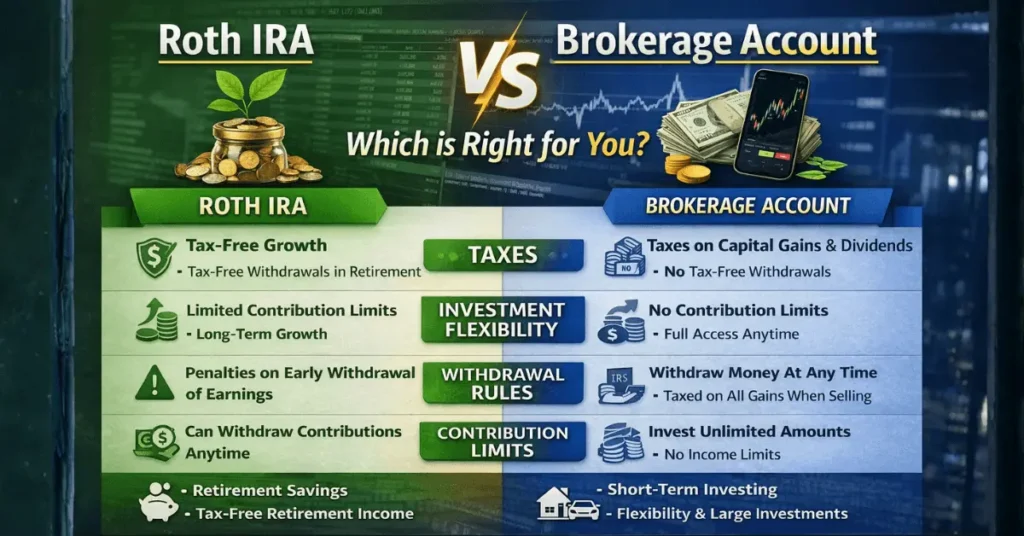
Roth IRA vs Brokerage Account: Which One Should You Choose?
Both Roth IRAs and brokerage accounts are powerful tools for growing your money, but they serve different purposes. Choosing between the two depends on your financial goals, timeline, and how much flexibility you need with your investments.
Key Takeaways:
- Roth IRA:
- Best for long-term retirement savings with tax-free growth and tax-free withdrawals.
- Ideal if you want to avoid Required Minimum Distributions and you’re comfortable following withdrawal rules.
- Great for young investors who want to grow their money without worrying about taxes in the future.
- Brokerage Account:
- Offers flexibility to invest large amounts and access your money anytime without penalties.
- Ideal for short-term financial goals, such as buying a house or funding a child’s education.
- More investment options and control over your portfolio, but you’ll need to pay taxes on your gains.
Which One Should You Choose?
- If your goal is to save for retirement and you’re okay with long-term growth, a Roth IRA might be the best choice due to its tax-free growth and tax-free withdrawals in retirement.
- If you need immediate access to your money or want to invest large amounts, a brokerage account might be better for your needs, as it gives you full flexibility to access funds and invest in whatever you choose.
Next Steps:
- Use a Roth IRA Calculator: To see how a Roth IRA could impact your retirement savings, use a Roth IRA calculator to estimate potential tax savings and growth.
- Consult a Financial Advisor: If you’re unsure about which account is right for your financial goals, consider consulting a financial advisor who can help you choose the best option based on your needs.
Start planning your future today! Whether you decide to open a Roth IRA or a brokerage account, making an informed choice is the first step towards achieving your financial goals. Get started now and take control of your financial future!