SOA OS23 2026 represents the continued relevance and evolution of SOA OS23 as a system-oriented architectural concept rather than a role-specific or job-focused framework. As interest around this keyword grows, particularly with future-year intent, clarity is required to understand what SOA OS23 actually is, how it functions, and why it remains relevant in modern distributed and enterprise systems approaching 2026.
What Is SOA OS23?
SOA OS23 refers to a system-level implementation and interpretation of Service-Oriented Architecture principles designed to support modular, interoperable, and scalable service-based systems. It focuses on structuring software systems as a collection of loosely coupled services that communicate through defined interfaces, enabling flexibility and long-term maintainability.
Definition of SOA OS23
SOA OS23 can be defined as a structured architectural system that applies service-oriented principles to organize, expose, and manage services across distributed environments.
Core Purpose and Design Philosophy
The core philosophy behind SOA OS23 is to decouple system components so that services can evolve independently while remaining interoperable within a larger ecosystem.
How SOA OS23 Fits Within Service-Oriented Architecture
SOA OS23 operates as an applied system model within the broader SOA paradigm, emphasizing governance, integration logic, and system-level consistency rather than application-level tooling.
Understanding SOA OS23 as a System
SOA OS23 is frequently misunderstood due to content that frames it around specific job roles, but its actual design intent is system-centric rather than persona-driven. Understanding it as a system clarifies its applicability across multiple technical and organizational contexts.
Why SOA OS23 Is Not Role-Specific
SOA OS23 defines how services interact within a system, not how a particular professional role uses them, making it applicable to architects, engineers, and IT teams alike.
Difference Between SOA OS23 and Job-Oriented Frameworks
Job-oriented frameworks focus on workflows or tools for specific roles, whereas SOA OS23 defines architectural rules governing service interaction and system structure.
Common Misinterpretations Online
Many explanations incorrectly label SOA OS23 as a data-science-oriented framework, which limits its perceived scope and obscures its system-level purpose.
System vs Role Comparison
| Aspect | SOA OS23 | Role-Based Frameworks |
|---|---|---|
| Scope | System-wide | Job-specific |
| Purpose | Architecture & integration | Task execution |
| Audience | Organizations & teams | Individual roles |
Core Architecture of SOA OS23
The architecture of SOA OS23 is built around clearly defined components that support service communication, governance, and scalability across distributed systems.

Structural Components
Key components include service providers, service consumers, service registries, and integration layers that coordinate communication.
Communication Model
SOA OS23 relies on standardized communication protocols and message-based interaction to ensure interoperability.
Data Flow and Integration Logic
Data flows through defined service interfaces, allowing systems to integrate without tight coupling.
Security and Governance Layer
Governance mechanisms enforce policies related to access control, service versioning, and compliance.
Architecture Components Table
| Component | Function |
|---|---|
| Service Provider | Delivers functionality |
| Service Consumer | Uses services |
| Registry | Enables discovery |
| Governance Layer | Enforces policies |
Key Concepts and Terminology in SOA OS23
Understanding SOA OS23 requires familiarity with core architectural concepts that define how services are designed and managed.
Services
Services are self-contained units of functionality exposed through interfaces.
Interfaces
Interfaces define how services communicate without exposing internal implementation.
Loose Coupling
Loose coupling allows services to change independently without breaking system dependencies.
Reusability
Reusable services reduce redundancy and improve development efficiency.
Interoperability
Interoperability ensures services can operate across platforms and technologies.
Concept Summary
- Modular design
- Independent service evolution
- Standardized communication
- Long-term maintainability
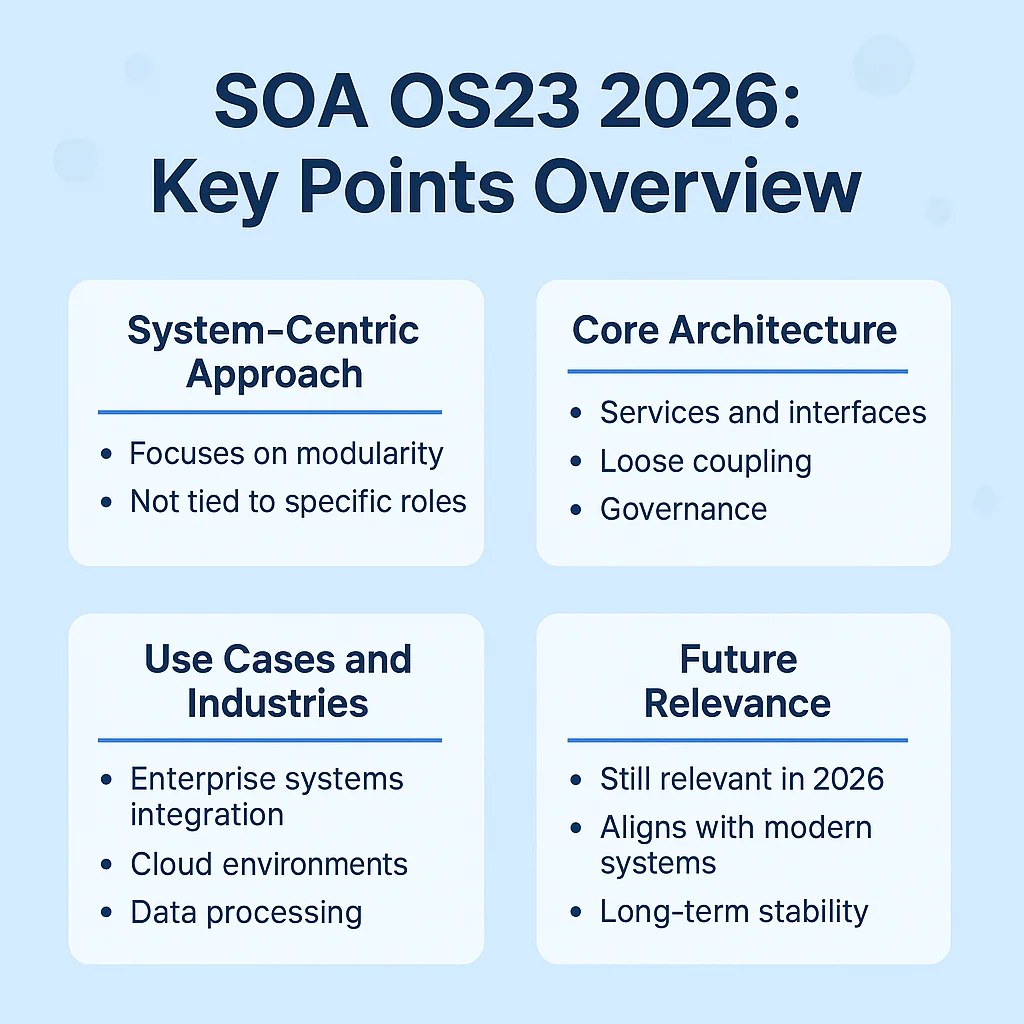
SOA OS23 Use Cases Across Industries
SOA OS23 supports a wide range of use cases across industries where distributed systems and integration are required.
Enterprise Systems Integration
Organizations use SOA OS23 to connect legacy systems with modern applications.
Cloud and Hybrid Environments
SOA OS23 supports hybrid architectures by enabling seamless service interaction across environments.
Data Processing Pipelines
Service-based pipelines allow data processing tasks to scale independently.
Business Process Automation
Automated workflows benefit from reusable and orchestrated services.
Use Case Table
| Industry | Use Case |
|---|---|
| Finance | System integration |
| Healthcare | Data interoperability |
| Retail | Process automation |
| IT | Cloud integration |
SOA OS23 vs Traditional SOA Implementations
While SOA OS23 is grounded in traditional SOA principles, it reflects refinements that address modern system complexity.
Architectural Differences
SOA OS23 emphasizes governance and scalability more strongly than early SOA models.
Scalability and Flexibility
Improved modularity supports horizontal scaling.
Maintenance and Governance
Centralized governance improves system oversight.
Comparison Table
| Aspect | Traditional SOA | SOA OS23 |
|---|---|---|
| Governance | Limited | Strong |
| Scalability | Moderate | High |
| Integration | Basic | Advanced |
SOA OS23 in 2026: Evolution and Market Relevance
The relevance of SOA OS23 in 2026 is driven by ongoing demand for scalable, interoperable system architectures.
Why SOA OS23 Still Matters in 2026
Distributed systems continue to require structured integration approaches.
Alignment With Modern Distributed Systems
SOA OS23 complements microservices and cloud-native designs.
Compatibility With Emerging Technologies
The architecture adapts to evolving platforms without fundamental redesign.
Evolution Overview
| Year | Focus |
|---|---|
| 2023 | Structural maturity |
| 2024 | Scalability focus |
| 2025 | Hybrid integration |
| 2026 | Long-term stability |
Performance, Scalability, and Reliability Considerations
Performance and reliability are central to SOA OS23’s system design.
System Performance Factors
Latency and throughput depend on service orchestration and communication efficiency.
Scaling Strategies
Independent service scaling improves system resilience.
Fault Tolerance and Reliability
Redundancy and isolation limit failure impact.
Security and Compliance Considerations
Security is integrated into SOA OS23 at the architectural level.
Access Control
Role-based and policy-driven access ensures secure service use.
Data Protection
Encryption and validation safeguard data in transit.
Regulatory Alignment
Compliance mechanisms support industry regulations.
Who Should Use SOA OS23 in 2026?
SOA OS23 is suited to organizations managing complex, distributed systems.
System Architects
Architects design scalable system structures.
Backend Engineers
Engineers implement and maintain services.
Enterprise IT Teams
IT teams manage integration and governance.
Organizations With Distributed Systems
Large systems benefit most from service-oriented structure.
Ideal User Summary
SOA OS23 is best suited for organizations prioritizing scalability, interoperability, and governance.
Advantages and Limitations of SOA OS23
Evaluating benefits and constraints provides a balanced view.
Advantages
- Strong modularity
- Scalable architecture
- Improved maintainability
Limitations
- Higher initial complexity
- Requires governance discipline
Pros and Cons Table
| Pros | Cons |
|---|---|
| Scalability | Complexity |
| Reusability | Governance overhead |
| Flexibility | Learning curve |
Frequently Asked Questions
What is SOA OS23 used for?
It is used to design and manage service-oriented systems.
Is SOA OS23 still relevant in 2026?
Yes, due to ongoing demand for scalable system architectures.
Is SOA OS23 a tool or architecture?
It is an architectural system, not a tool.
How is SOA OS23 different from microservices?
SOA OS23 emphasizes governance and integration at scale.
Who should learn SOA OS23?
Architects, engineers, and enterprise teams.
Can SOA OS23 scale for large systems?
Yes, scalability is a core design goal.
Key Takeaways
- SOA OS23 is system-centric, not role-based
- Remains relevant in 2026
- Supports scalable, interoperable architectures
- Requires governance for success
Conclusion
SOA OS23 2026 represents a mature, system-oriented architectural approach aligned with modern distributed environments. Its focus on modularity, governance, and interoperability positions it as a long-term solution for organizations managing complex systems. As architectural demands evolve, SOA OS23 continues to provide a structured foundation rather than a role-specific framework.
References
- Service-Oriented Architecture standards
- Distributed systems design principles
- Enterprise integration best practices
- Architectural governance models