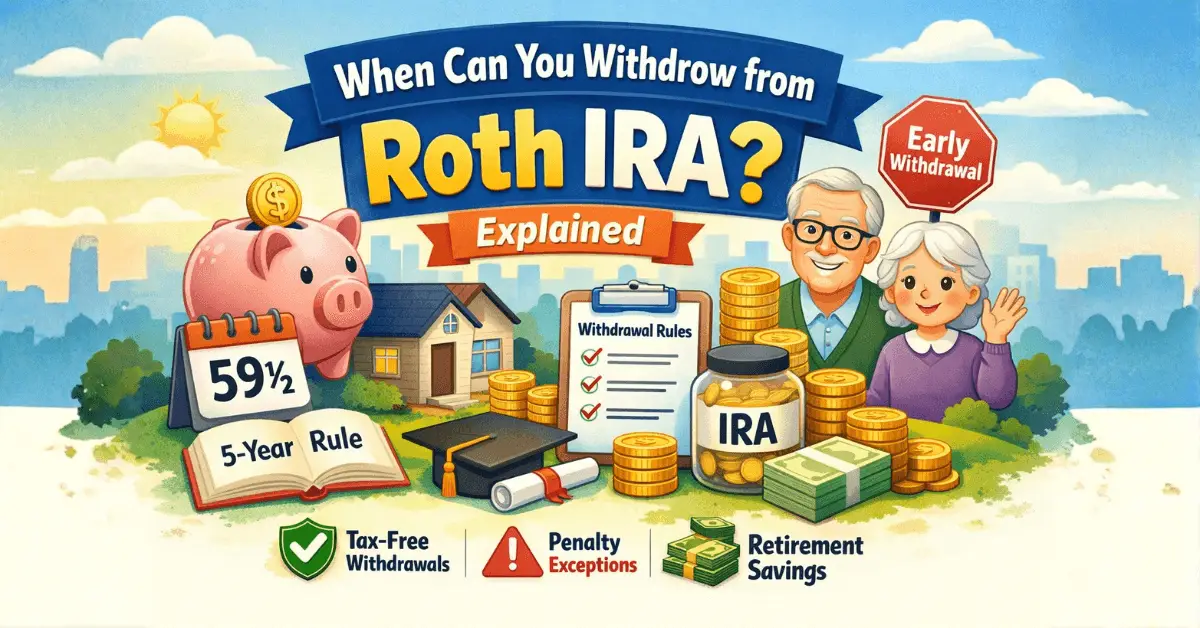
A Roth IRA is a special type of savings account that helps you save money for when you are older and stop working. The cool part is that your money grows tax-free, and when you take it out in the future, you don’t have to pay taxes on it!
But, just like any other savings account, there are rules about when you can take the money out of a Roth IRA. We’ll explain when you can withdraw money from your Roth IRA, how to avoid penalties, and what you need to know to get the most from your savings.
Basic Roth IRA Withdrawal Rules
When you have a Roth IRA, there are some basic rules you need to know about withdrawing money. These rules will help you avoid any surprises, like paying extra taxes or penalties.
What is the Rule About Age? (The 59½ Rule)
One of the main rules is that you can only take earnings (the extra money your account makes from interest, dividends, and growth) tax-free once you are at least 59½ years old.
- Think of it like this: Imagine you saved your allowance money in a piggy bank, but it’s locked up for a long time. You can put money in, but you can only take it out without paying a fee when you’re old enough (59½ years old). Before that, you might have to pay a penalty if you take it out early!
What’s the Difference Between Contributions and Earnings?
You can always take out the money you put in (your contributions) without paying any taxes or penalties. This is different from your earnings (the extra money your account makes). You can withdraw your contributions whenever you want without any problems.
- Example: Let’s say you put $5,000 into your Roth IRA. If you decide you need that $5,000 back, you can take it out anytime—no tax, no penalty, no problem! But, if your $5,000 grew into $6,000 over time (the extra $1,000 is your earnings), you have to wait until you’re 59½ years old and meet certain rules before you can take out that $1,000 tax-free.
When Can You Withdraw Your Contributions?
One of the best things about a Roth IRA is that you can always take out the money you put into it—your contributions—whenever you want. And guess what? You don’t have to pay any taxes or penalties when you take out your contributions.
What Are Contributions?
Your contributions are the money that you put into the Roth IRA yourself. For example, if you put in $3,000 of your own savings into your Roth IRA, that $3,000 is your contribution.
- Example: Let’s say you saved $3,000 from your summer job and decided to put it in your Roth IRA. If you need to take that money out, you can do it whenever you want, without paying any penalties or taxes.
Why Can You Withdraw Contributions Anytime?
The reason you can take out your contributions anytime is because it’s your own money. The government lets you take it out whenever you want because you already paid taxes on it when you put it in.
- Think of it like this: It’s like putting $5 in a piggy bank, and if you need that $5 later, you can take it out anytime. The $5 is yours, and you don’t have to ask anyone for permission to get it back!
Can You Withdraw Contributions and Earnings Together?
It’s important to remember that you can’t withdraw both your contributions and earnings at the same time without following the rules for earnings (like waiting until you’re 59½ or meeting the 5-year rule for tax-free earnings). If you want to take out earnings, you need to follow the rules we talked about in Section 1.
- Example: If you put in $5,000 and your account grows to $6,000, you can take out the $5,000 contribution anytime. But if you want the $1,000 earnings, you need to meet the age and 5-year rule.
The 5-Year Rule for Roth IRA Earnings
When it comes to withdrawing the earnings in your Roth IRA (the money your contributions have earned over time), there’s a special rule called the 5-Year Rule. This rule is super important to understand because it helps you figure out when you can take out your earnings tax-free.
What is the 5-Year Rule?
The 5-Year Rule says that in order to take out your earnings from your Roth IRA tax-free, the Roth IRA must be open for at least 5 years. Plus, you need to be 59½ years old or older.
- Example: If you opened your Roth IRA in 2021, you would need to wait until at least 2026 (5 years later) to take out your earnings tax-free, and you also need to be 59½ years old or older. So, you can’t just take the money out before 59½, even if you’ve had your account for 5 years.
Why Does the 5-Year Rule Matter?
The 5-Year Rule is there to make sure that Roth IRA savings are used for long-term retirement and not as a short-term savings account. The government wants to encourage you to save for retirement, so it gives you tax-free earnings if you leave the money in the account for 5 years or more.
- Think of it like this: Imagine you plant a tree (your Roth IRA) and you need to wait 5 years for it to grow strong enough to bear fruit (your earnings). If you try to take the fruit before the tree has grown enough (before the 5 years), you can’t enjoy the full benefit of it.
When Can You Withdraw Earnings Tax-Free?
You can withdraw your earnings from your Roth IRA tax-free once both of these two things happen:
- The Roth IRA has been open for 5 years.
- You are at least 59½ years old.
- Example: If you opened your Roth IRA in 2021, you could start withdrawing your earnings tax-free in 2026, as long as you’re 59½ or older by then.
What If I Don’t Meet the 5-Year Rule?
If you try to take out earnings before the 5 years are up, you might have to pay taxes and possibly penalties. However, if you’re 59½ or older, you can still take out your earnings, but you’ll be subject to taxes if you haven’t met the 5-year rule.
- Example: If you opened your Roth IRA in 2021, but you want to take money out in 2024 (before the 5 years), you’ll have to pay taxes on the earnings, even if you’re already 59½ years old.
Early Withdrawals from Roth IRA
Sometimes, you might need to take money out of your Roth IRA before you’re 59½ years old. While this is usually not a good idea because it can come with penalties and taxes, there are exceptions that let you take money out early without penalties. Let’s take a closer look at early withdrawals and what the rules are.
What Happens if You Withdraw Early?
If you take money out of your Roth IRA before you turn 59½ years old, you usually have to pay a 10% penalty on the earnings (the extra money your account made) and possibly taxes on the money you withdraw.
However, the good news is that you can avoid these penalties and taxes if you meet certain exceptions. Let’s go over those exceptions so you can know what to expect.
Exceptions to Early Withdrawal Penalties
Here are the most common exceptions that allow you to take money out of your Roth IRA early without penalties:
- First-Time Home Purchase:
If you’re buying your first home, you can withdraw up to $10,000 of earnings from your Roth IRA without penalty to use for your down payment or other costs of buying a house. You still need to meet the 5-year rule for the earnings.- Example: If you’ve had your Roth IRA for 3 years and you want to buy your first house, you can take out up to $10,000 of earnings without paying penalties, as long as the Roth IRA has been open for at least 5 years.
- Qualified Education Expenses:
You can withdraw money from your Roth IRA to pay for college or other higher education costs without penalty. Again, you still need to meet the 5-year rule for the earnings.- Example: If you want to pay for your college tuition, you can use your Roth IRA funds, but if you’re under 59½, you need to follow the rules to avoid taxes on the earnings.
- Disability:
If you become disabled, you can take money out of your Roth IRA without paying penalties or taxes, even if you’re under 59½. - Death:
If you pass away, your heirs (the people you leave your Roth IRA to) can take out the money without paying penalties or taxes. - Medical Expenses:
You can also withdraw money for medical expenses that are more than 7.5% of your income without penalties. However, you might still need to pay taxes on the earnings. - Health Insurance:
If you lose your job and need to pay for health insurance, you can use your Roth IRA funds penalty-free to cover that cost, if you meet certain requirements.
Remember: Taxes on Earnings
Even if you qualify for one of the exceptions to the penalty, you still may have to pay taxes on the earnings if you haven’t met the 5-year rule. This means that, while you can avoid the 10% penalty, you might still owe taxes on the earnings you withdraw early.
- Example: If you are 30 years old and need $5,000 for medical expenses, you can take the money out penalty-free (if you meet the exception). But if you haven’t met the 5-year rule, you might still owe taxes on the earnings.
How to Withdraw from Your Roth IRA
Now that we know the rules about when and how you can withdraw money from your Roth IRA, let’s talk about the process of actually taking money out. Withdrawing money from your Roth IRA is simple, but it’s important to follow the right steps to make sure everything goes smoothly.
Step 1: Contact Your Roth IRA Custodian
The first step in withdrawing money is to contact the custodian or financial institution where your Roth IRA is held. Your custodian could be a bank, brokerage, or investment company. This is the place that manages your Roth IRA.
- Example: If you opened your Roth IRA with a bank, you will need to call or go to their website to begin the withdrawal process.
When you contact your custodian, they will ask you for some details, like:
- How much money you want to withdraw.
- Whether you’re withdrawing just contributions or earnings (or both).
- Whether you’re taking out the money for an approved reason (like a first-time home purchase, education, or medical expenses).
Step 2: Choose How You Want to Receive the Money
Once you contact your custodian, you’ll need to decide how you want to receive the money. There are a few options:
- Check: The custodian can send you a paper check.
- Direct Deposit: You can have the money directly deposited into your bank account.
- Wire Transfer: For faster access, you might be able to have the funds sent through a wire transfer.
- Example: If you want the money quickly, you might choose direct deposit to get the money in your bank account right away.
Step 3: Taxes and Penalties (If Applicable)
If you are withdrawing earnings (the money your account made from interest or investments), make sure you understand any taxes or penalties that could apply. This depends on whether you meet the 5-year rule and are 59½ or older.
- If you’re under 59½ and you withdraw earnings: You might need to pay a 10% penalty plus taxes on the earnings, unless you meet an exception (like using the money for a first-time home purchase).
- If you meet the 5-year rule and are over 59½: You can take out both contributions and earnings tax-free and penalty-free.
It’s important to talk to your custodian about whether any taxes or penalties will apply, so you know exactly what to expect.
Step 4: Completing the Paperwork
You will likely need to fill out some paperwork to complete the withdrawal. This paperwork helps the custodian keep track of the money you’re taking out and ensures everything is done properly.
- Example: You might have to fill out a form that asks for your personal details, the amount you want to withdraw, and how you want to receive the money.
Step 5: Wait for Your Money
After you’ve submitted your withdrawal request, the custodian will process it. This can take anywhere from a few days to a couple of weeks, depending on the method you choose (e.g., check, direct deposit, or wire transfer).
- Example: If you asked for a check, it might take a week to arrive in the mail. If you requested a wire transfer, it could be available within 1-2 business days.
Tax Implications of Roth IRA Withdrawals
One of the reasons many people love a Roth IRA is that, in most cases, you don’t have to worry about taxes when you take money out. However, it’s important to understand when you might have to pay taxes or penalties on your withdrawals. Let’s break it down in simple terms.
When Are Roth IRA Withdrawals Tax-Free?
Here’s the good news: Roth IRA withdrawals are usually tax-free, which means you don’t have to pay any taxes when you take out money. But this only applies under certain conditions:
- You’re 59½ or older.
- Your Roth IRA has been open for at least 5 years.
If both of these conditions are met, you can take out your contributions and earnings without paying any taxes or penalties. This is the best-case scenario!
- Example: If you opened your Roth IRA in 2021 and you’re 60 years old in 2031, you can take out all of your money tax-free. You’ve met the 5-year rule and the 59½ rule.
When Will You Have to Pay Taxes on Roth IRA Withdrawals?
Even though Roth IRA withdrawals are usually tax-free, there are some cases where you may have to pay taxes:
- If You Withdraw Earnings Before 59½: If you’re under 59½ years old and you take out earnings (the money your contributions made), you’ll likely have to pay taxes on those earnings.
- Example: If you’re 40 years old and withdraw $1,000 of earnings, you’ll have to pay taxes on the $1,000, plus possibly a penalty (unless you qualify for one of the exceptions like buying your first home or paying for college).
- If You Haven’t Met the 5-Year Rule: If your Roth IRA hasn’t been open for at least 5 years, you might have to pay taxes on earnings that you take out. Again, this applies mostly to earnings, not contributions.
- Example: If you’ve had your Roth IRA for only 2 years and you withdraw earnings, you will have to pay taxes on those earnings.
What About Penalties?
If you withdraw earnings before you turn 59½ and don’t qualify for an exception (like buying a house or paying for medical expenses), you could face a 10% penalty on the amount you withdraw, in addition to the taxes on the earnings.
- Example: Let’s say you’re 35 years old and you take out $2,000 in earnings. You’ll likely pay taxes on the $2,000, plus a penalty of $200 (which is 10% of $2,000), unless you qualify for an exception.
Exceptions to the 10% Penalty
If you withdraw money before 59½ but meet certain conditions, you can avoid the 10% penalty, even if you still have to pay taxes on the earnings. Some common exceptions are:
- First-time home purchase (up to $10,000).
- Qualified education expenses (like college).
- Disability (if you become unable to work).
- Health insurance premiums if you’re unemployed.
- Example: If you withdraw $5,000 for college expenses before you turn 59½, you can avoid the penalty, but you may still have to pay taxes on the earnings.
When Do You Not Have to Worry About Taxes or Penalties?
You don’t have to worry about taxes or penalties if:
- You’re withdrawing only your contributions (your original money).
- You’re 59½ or older and your Roth IRA has been open for 5 years or more.
- You meet an exception like buying your first home or paying for college.
Roth IRA vs. Traditional IRA Withdrawal Rules
When you’re saving for retirement, you might come across two popular accounts: the Roth IRA and the Traditional IRA. While both are great ways to save for the future, their withdrawal rules are quite different. In this section, we’ll compare the withdrawal rules for Roth IRAs and Traditional IRAs to help you understand which one might work best for you.
Key Differences Between Roth IRA and Traditional IRA Withdrawals
Here are the main differences between withdrawing money from a Roth IRA versus a Traditional IRA:
| Feature | Roth IRA | Traditional IRA |
|---|---|---|
| Tax-Free Withdrawals | Yes, if you’re 59½ or older and the account is open for 5 years. | No, you have to pay taxes when you withdraw money. |
| Contributions | You can always withdraw contributions tax-free and penalty-free. | You cannot withdraw contributions without taxes until retirement. |
| Withdrawals Before 59½ | You can withdraw contributions anytime, but earnings are taxed and penalized if withdrawn early. | Withdrawals before 59½ are taxed and penalized unless you meet exceptions. |
| Required Minimum Distributions (RMDs) | No RMDs during your lifetime. | You must start taking RMDs at age 72. |
| Taxes on Withdrawals | You don’t pay taxes on contributions or qualified withdrawals. | You pay taxes on all withdrawals, including contributions and earnings. |
1. Taxes on Withdrawals
The biggest difference between the two accounts is how they handle taxes on withdrawals:
- Roth IRA: You’ve already paid taxes on your contributions when you put them in. This means you can take out contributions whenever you want tax-free. If you follow the rules (you’re 59½ or older, and your Roth IRA has been open for 5 years), you can also take out your earnings tax-free.
- Traditional IRA: The government hasn’t taxed your contributions yet. When you take money out, you have to pay taxes on both your contributions and earnings.
2. Required Minimum Distributions (RMDs)
With a Traditional IRA, the IRS forces you to start taking a certain amount of money out after you turn 72. This is called a Required Minimum Distribution (RMD). Even if you don’t need the money, you must take it out and pay taxes on it.
With a Roth IRA, there are no RMDs during your lifetime. This means you can leave your money in the account as long as you want, letting it continue to grow.
- Example: If you have a Roth IRA and you’re 75, you don’t have to take any money out if you don’t want to. In a Traditional IRA, you’d have to start taking money out after 72, even if you don’t need it.
3. Withdrawals Before 59½
Both accounts have rules for withdrawing money before you turn 59½:
- Roth IRA: You can always withdraw your contributions without paying taxes or penalties. However, if you want to take out earnings, you’ll usually pay taxes and a penalty, unless you meet an exception (like buying a first home or paying for college).
- Traditional IRA: If you withdraw money before 59½, you’ll face taxes and a 10% penalty unless you meet an exception (like using the money for medical expenses or buying your first home).
4. Which One Is Better for You?
Choosing between a Roth IRA and a Traditional IRA depends on your current and future tax situation:
- If you think you’ll be in a higher tax bracket in the future, a Roth IRA is a good choice because you pay taxes now and withdraw tax-free later.
- If you think you’ll be in a lower tax bracket when you retire, a Traditional IRA might be better because you get a tax break now, but you’ll pay taxes when you withdraw money in the future.
Understanding when and how you can withdraw from your Roth IRA is crucial for making the most of your retirement savings. Here’s a quick recap of the key takeaways:
- Withdrawals are Tax-Free and Penalty-Free: You can always withdraw your contributions to your Roth IRA anytime without paying taxes or penalties. But to withdraw earnings tax-free, you need to be 59½ years old and have your Roth IRA open for at least 5 years.
- Exceptions for Early Withdrawals: If you need to withdraw money before 59½, there are certain exceptions (like using the money for a first-time home purchase, education, or medical expenses) that allow you to avoid penalties.
- Tax Implications: Roth IRA withdrawals are mostly tax-free, but if you withdraw earnings early or haven’t met the 5-year rule, you might have to pay taxes and penalties.
- Roth IRA vs. Traditional IRA: Roth IRAs offer more flexibility since they don’t require Required Minimum Distributions (RMDs), and you can withdraw your contributions anytime. With a Traditional IRA, you have to start taking money out at age 72, and you must pay taxes on withdrawals.
Remember, a Roth IRA is a powerful tool for tax-free retirement savings, but it’s important to understand the rules to avoid unnecessary penalties and taxes. If you’re thinking about withdrawing from your Roth IRA, make sure you know the right steps to take, and consider consulting a financial advisor to make the most of your retirement savings.
Now that you understand the rules and benefits of Roth IRA withdrawals, it’s time to take control of your savings. Whether you’re just starting your Roth IRA or looking to withdraw money for an important reason, make sure you follow the guidelines to avoid any penalties. If you’re unsure about the best way to manage your Roth IRA, consider talking to a financial advisor who can help you create a plan for the future.